Overview
Compartment syndrome of the forearm is one of the most critical surgical emergencies in orthopaedics. It occurs when pressure within the fascial compartments of the forearm exceeds the perfusion pressure of the small vessels within the compartment — causing ischaemia of the muscles and nerves within those compartments. If not decompressed (fasciotomy) within 6 hours of onset, irreversible muscle necrosis and nerve damage occur — resulting in Volkmann’s ischaemic contracture: a devastating deformity of wrist and finger flexion that causes permanent disability.
The pathophysiology is a positive feedback cycle: injury causes bleeding and oedema → pressure rises in the closed fascial compartment → blood flow to the muscles and nerves is cut off → ischaemia causes further muscle swelling → pressure rises further → complete circulatory shut-down within the compartment. The bones and arteries are unaffected (the patient may have a normal radial pulse) while the compartment contents are dying.
The cardinal clinical signs of compartment syndrome (the “6 Ps”) are: Pain out of proportion (severe pain disproportionate to the injury), Pressure (tense swollen forearm), Paraesthesia (tingling in the fingers, particularly the median nerve distribution), Paralysis (weakness of finger and wrist flexion), Pallor, and Pulselessness (a late sign — by the time the pulse is lost, irreversible damage is already occurring). Pain with passive stretching of the fingers is the earliest and most sensitive sign.
Quick Facts | Details |
Also Known As | Forearm Compartment Syndrome, Volar Compartment Syndrome, Volkmann’s Ischaemia (established) |
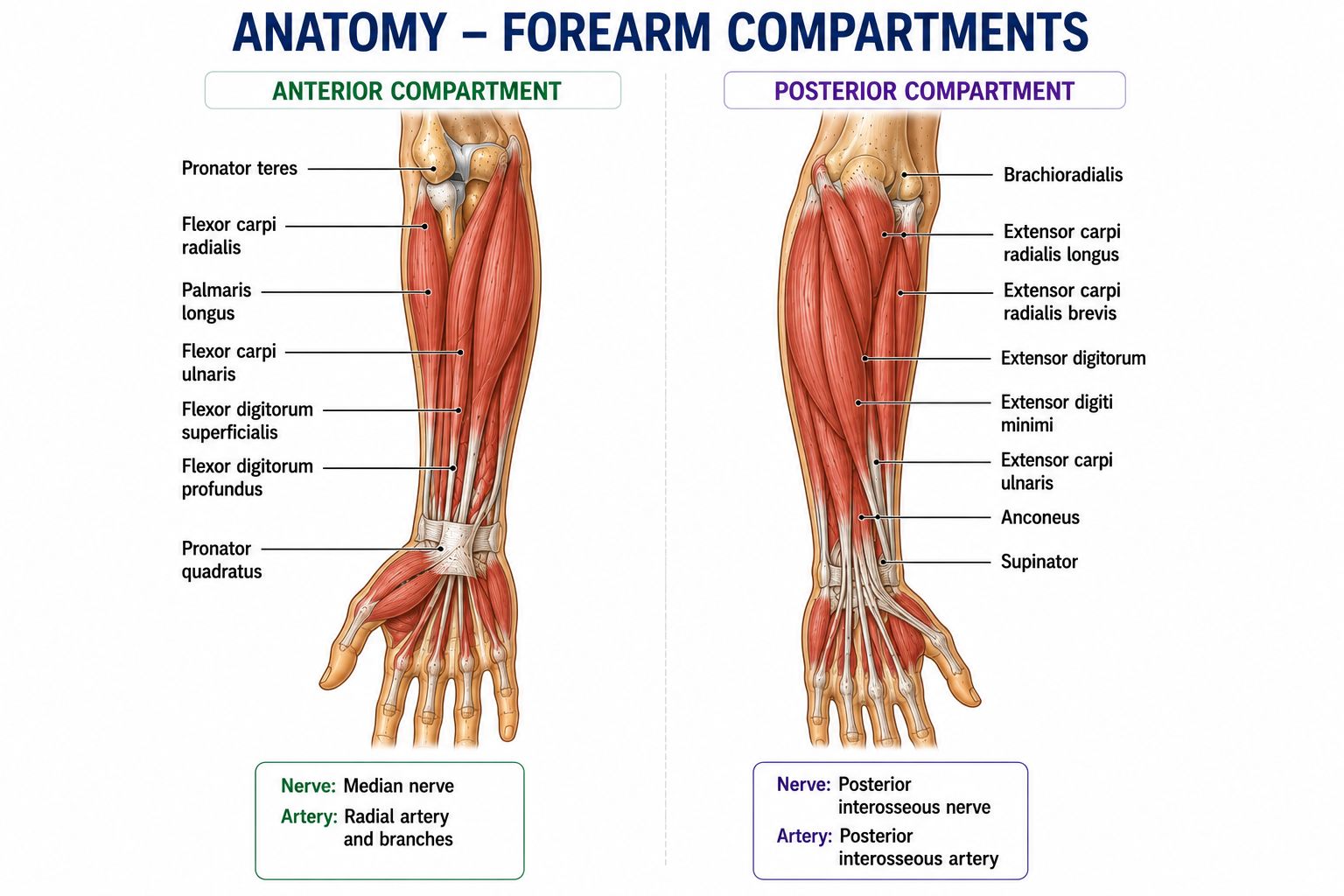
Affected Area | Forearm compartments — the volar (anterior) compartment containing the flexor muscles, median nerve, and radial and ulnar arteries; the dorsal (posterior) compartment containing the extensor muscles; the mobile wad; the elbow region |
Who It Affects | Any patient with a forearm or elbow injury, fracture, dislocation, or prolonged limb compression; children after supracondylar fractures are at particular risk; also occurs after crush injuries, reperfusion after vascular injury, excessive fluid extravasation, and tight bandaging |
Prevalence | Forearm compartment syndrome is a critical orthopaedic emergency; delay in diagnosis and treatment is the primary cause of Volkmann’s ischaemic contracture — a devastating, preventable disability; increasing awareness has improved outcomes but it remains underdiagnosed |
Treatment | SURGICAL EMERGENCY: fasciotomy within 6 hours of symptom onset; volar (Henry) approach decompressing all forearm compartments; dorsal fasciotomy if needed; concurrent carpal tunnel release; leave wounds open; delayed primary closure at 48–72 hours; Volkmann’s contracture after missed diagnosis requires extensive reconstructive surgery |
Causes & Risk Factors
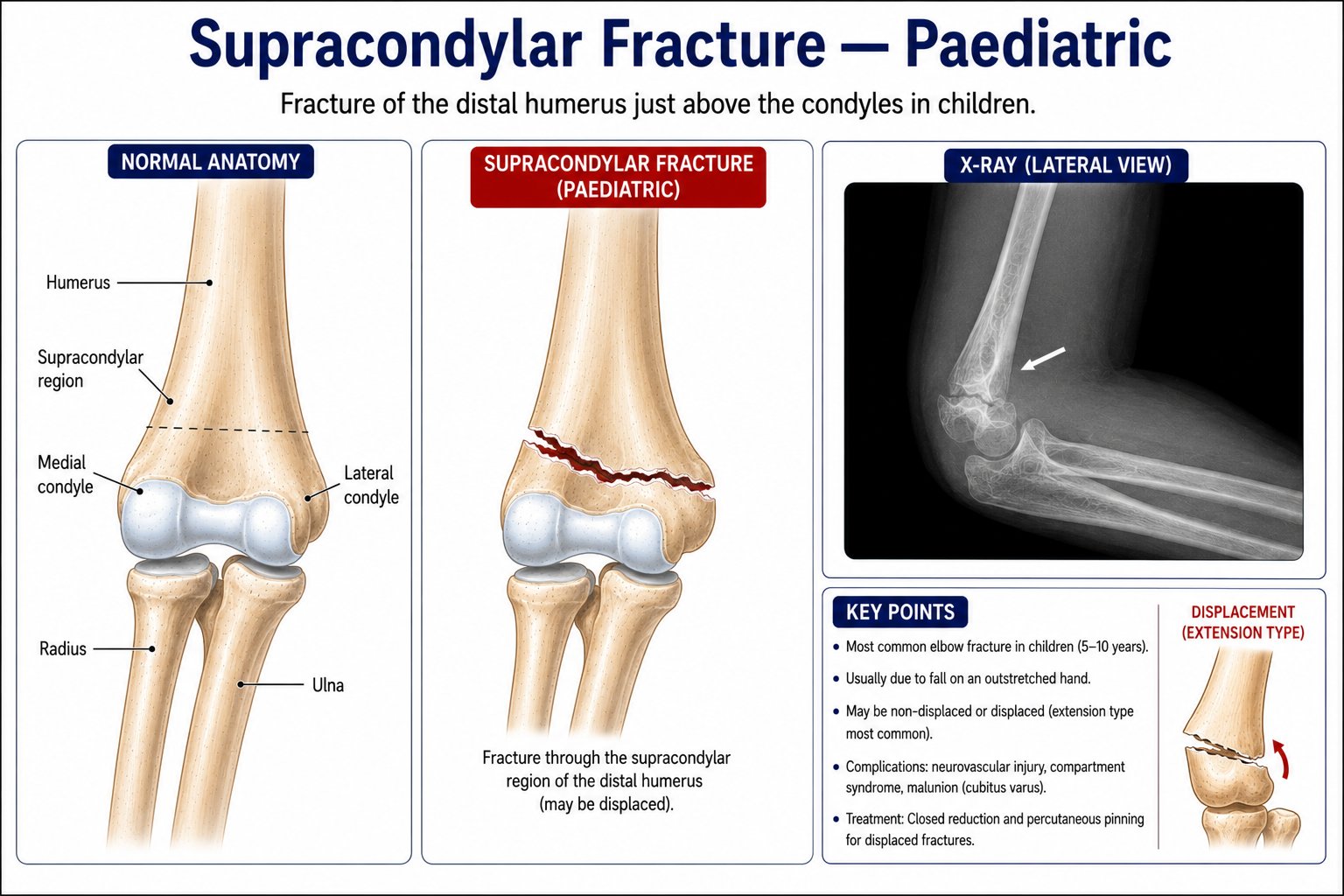
- Supracondylar fracture (paediatric) — one of the most common causes; the displaced proximal fragment can kink the brachial artery and cause forearm ischaemia; tight bandaging or cast after reduction worsens compartment pressure
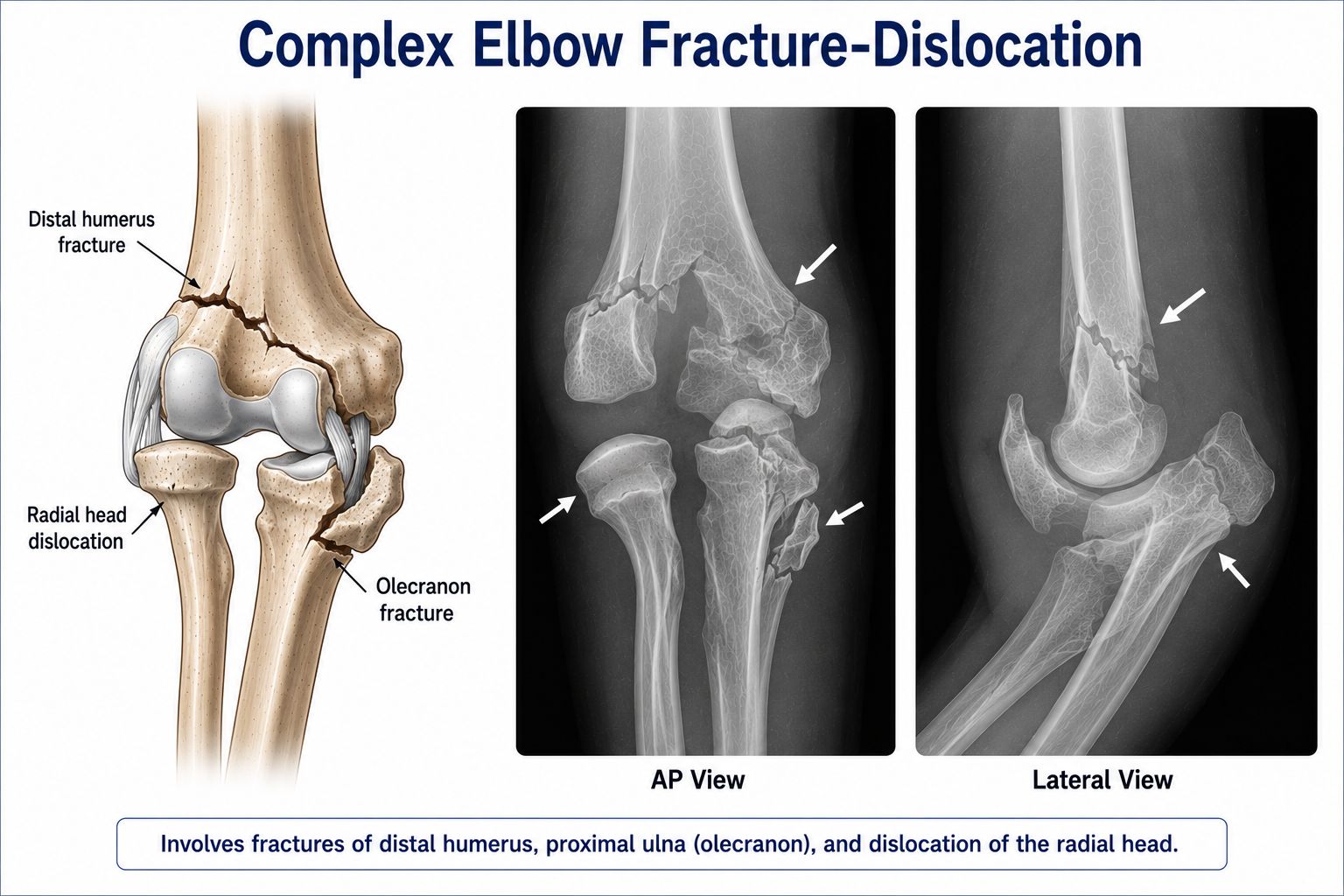
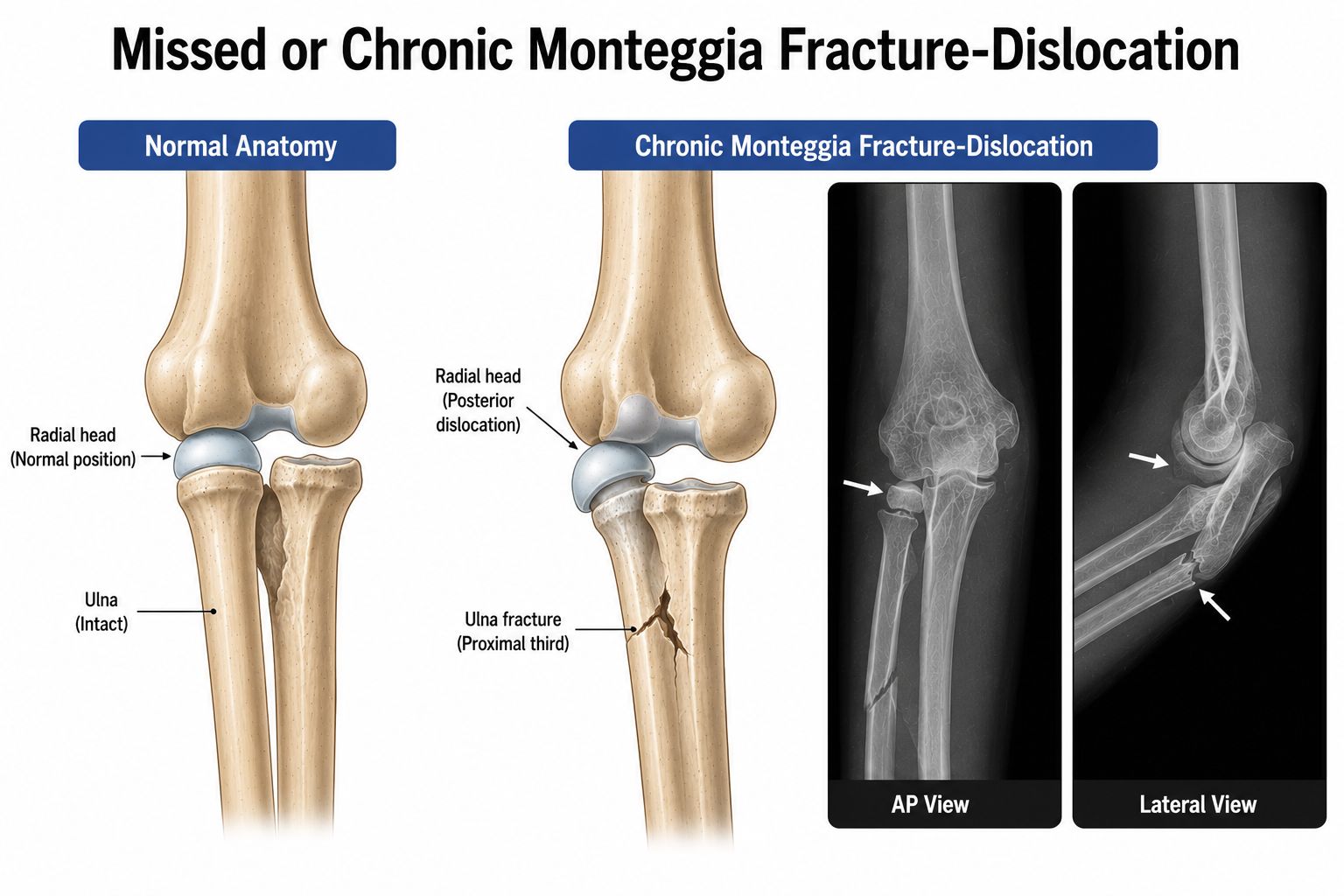
- Forearm fractures — both-bone forearm fractures; high-energy Monteggia or Galeazzi injuries
- Crush injury — prolonged compression of the forearm (pinning under a vehicle; industrial crush)
- Reperfusion after vascular injury — when blood flow is restored after arterial injury or tourniquet release, reperfusion oedema can cause compartment syndrome
- Burns — circumferential burns cause eschar constriction equivalent to a tight fascial sleeve
- Tight cast or bandage — the most iatrogenic cause; all casts and bandages applied to injured limbs must be bivalved (split) and padding removed at the first sign of compartment pressure
- Intravenous fluid extravasation — particularly in small children with poorly supervised IV lines; large volume extravasation into the forearm can cause compartment syndrome
Symptoms
- Severe, escalating pain — out of proportion to the injury; the most important early symptom; pain that is increasing rather than improving after fracture treatment
- Pain with passive finger extension (EARLIEST AND MOST SENSITIVE SIGN) — stretching the volar compartment muscles by passively extending the fingers reproduces severe pain; even one finger passively extended reproduces pain in the median nerve distribution
- Tense, firm forearm — the forearm feels “woody” or hard on palpation; the fascia is under extreme tension
- Tingling and numbness — in the finger tips (median and/or ulnar nerve distribution); early sensory loss
- Weakness — finger and wrist flexion weakness; indicates motor involvement
- Pallor and pulselessness — LATE signs; do not wait for these before acting — irreversible damage has already occurred by the time the pulse is lost
- Extreme agitation in children — a child in compartment syndrome will not be comforted; constant, extreme agitation and pain despite adequate analgesia
How is it Diagnosed?
- Clinical diagnosis — this is primarily a clinical diagnosis; do not wait for investigations when clinical signs are present
- Compartment pressure measurement — intracompartmental pressure measured with a needle pressure monitor; pressure >30 mmHg absolute, OR within 30 mmHg of diastolic blood pressure (delta pressure <30 mmHg) = fasciotomy required
- The “three As” of paediatric compartment syndrome: Agitation, Anxiety, increasing Analgesic requirement
- Plain X-rays — confirm underlying fracture pattern; do not delay decompression for imaging
- Vascular assessment — Doppler ultrasound if brachial artery injury is suspected; a normal pulse does NOT exclude compartment syndrome

Treatment Options
Treatment Type | Details |
EMERGENCY FASCIOTOMY — Within 6 Hours | Volar (Henry) approach: single S-shaped incision from medial arm across the elbow crease to the wrist; decompresses the volar compartment, mobile wad, and carpal tunnel; release all compartment fascia under direct vision; Dorsal fasciotomy if dorsal compartment also tense |
Concurrent Carpal Tunnel Release | All forearm fasciotomies should include concurrent carpal tunnel release — the carpal tunnel is the distal extension of the volar forearm compartment and must also be decompressed |
Open Wound Management | Wounds are left OPEN at the end of fasciotomy — do NOT close; skin cannot be closed without increasing compartment pressure; sterile non-adherent dressings; wound closure at 48–72 hours (delayed primary closure) when swelling has resolved |
Concurrent Fracture Management | If concurrent fracture: ORIF or external fixation after fasciotomy decompression; do not delay decompression for fracture fixation |
Vessel Repair | If concurrent vascular injury: revascularisation is performed urgently; fasciotomy is performed before or concurrent with vascular repair to prevent reperfusion compartment syndrome |
Volkmann’s Contracture Treatment (Missed CS) | Established contracture: requires extensive reconstructive surgery; flexor muscle slide (lengthening); tendon transfers; nerve repair; occupational therapy; outcomes are poor compared to prevention |
Recovery & Rehabilitation
- After timely fasciotomy (within 6 hours): excellent recovery of muscle and nerve function; wound closure at 48–72 hours; physiotherapy to prevent contracture
- Delayed fasciotomy (6–12 hours): partial recovery; some permanent weakness and sensory deficit possible
- Missed compartment syndrome leading to Volkmann’s contracture: permanent disability; multiple reconstructive procedures required; never fully normal
- Key message: outcomes are directly proportional to the speed of diagnosis and intervention; a 6-hour window is an absolute limit, not a guideline
Why choose Dr Senthilvelan?
Compartment syndrome demands immediate recognition and emergency surgical action — delay is catastrophic. Dr Senthilvelan has extensive experience performing emergency fasciotomies for forearm compartment syndrome and is acutely aware of the clinical signs that demand immediate decompression, including the subtle early signs in children.
Frequently Asked Questions
1. How do I know if my child has compartment syndrome after their elbow fracture was treated?
The warning signs in children are: constant, extreme agitation and crying that cannot be comforted despite pain medication; a forearm that feels hard and tense when touched; tingling or numbness in the finger tips; severe pain when any finger is passively straightened. In children, rising analgesic requirements after fracture treatment are the most important early warning sign. If you observe any of these signs, seek emergency orthopaedic assessment IMMEDIATELY — do not wait until the next day. This is a surgical emergency.
2. Why is compartment syndrome an emergency?
Compartment syndrome is an emergency because the window for intervention is approximately 6 hours from symptom onset. After this time, the muscle and nerve cells inside the compartment begin to die from ischaemia. After 12 hours, the damage is largely irreversible, leading to Volkmann’s ischaemic contracture — a permanent, severely disabling deformity of the wrist and fingers. Timely fasciotomy (surgical decompression) within 6 hours reliably prevents permanent damage. Every hour of delay beyond 6 hours significantly worsens the outcome.
3. What is Volkmann's ischaemic contracture?
Volkmann’s ischaemic contracture is the devastating end result of untreated or delayed compartment syndrome of the forearm. The muscle and nerve tissue inside the forearm dies from ischaemia, then scars and contracts. The result is a rigid, fixed deformity of wrist flexion, finger flexion, and forearm pronation that cannot be undone by physiotherapy. The hand is functionally severely limited. Treatment requires complex reconstructive surgery (muscle slide, tendon transfers, nerve grafts) that can improve but never normalise function. This is an entirely preventable complication.
4. My cast was put on after a forearm fracture and my hand is numb — what should I do?
This is an emergency. Numbness in the hand after a cast application may indicate that the cast is too tight and is causing compartment pressure to rise. You must seek emergency assessment immediately — do not wait. The first action taken by a medical professional will be to bivalve (split) the cast completely and remove all padding. If symptoms do not immediately improve with cast splitting, emergency fasciotomy is performed. Never be reassured by anyone that numbness after cast application is ‘normal’ — it is a red flag requiring urgent action.
5. The fasciotomy left a large scar on my arm — is this permanent?
Yes — the fasciotomy incisions leave permanent scars on the forearm. The volar (front-of-forearm) incision typically runs from near the elbow to the wrist. These scars mature over 12–18 months and become less prominent with time and scar massage. Functional outcomes after timely fasciotomy are generally excellent — the preserved muscle and nerve function is far more important than the cosmetic appearance of the scar. Scar management (silicone gel, massage, sun protection) is started from 6 weeks post-closure.