Overview
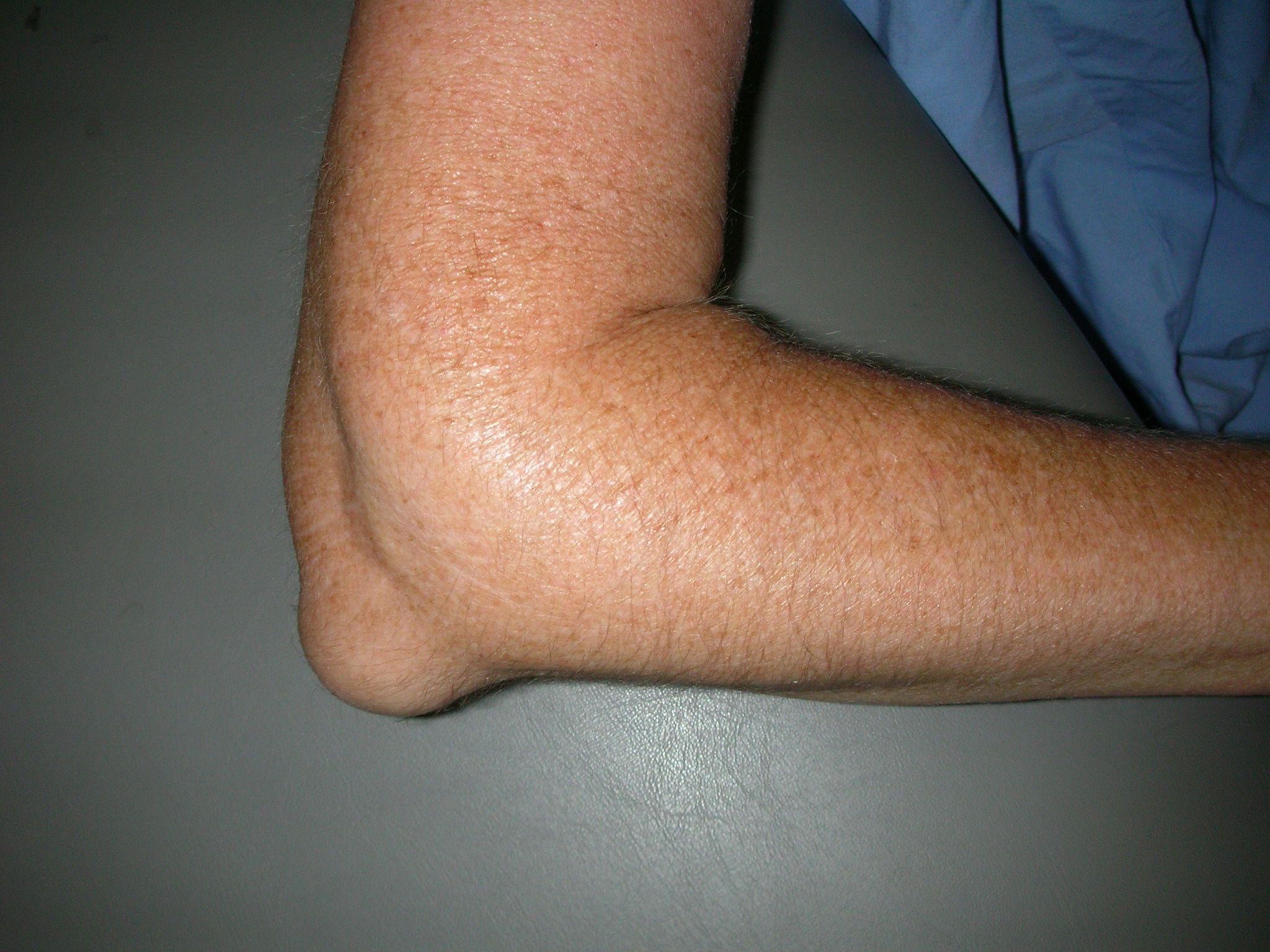
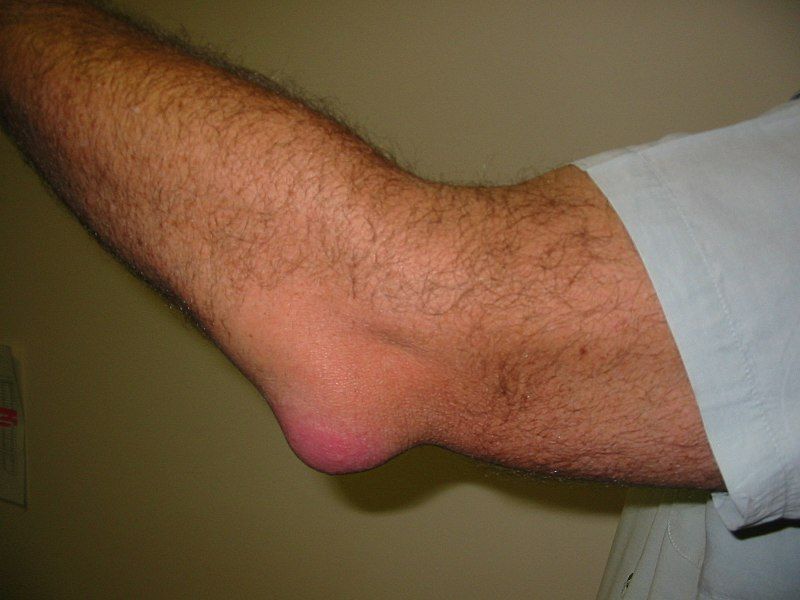
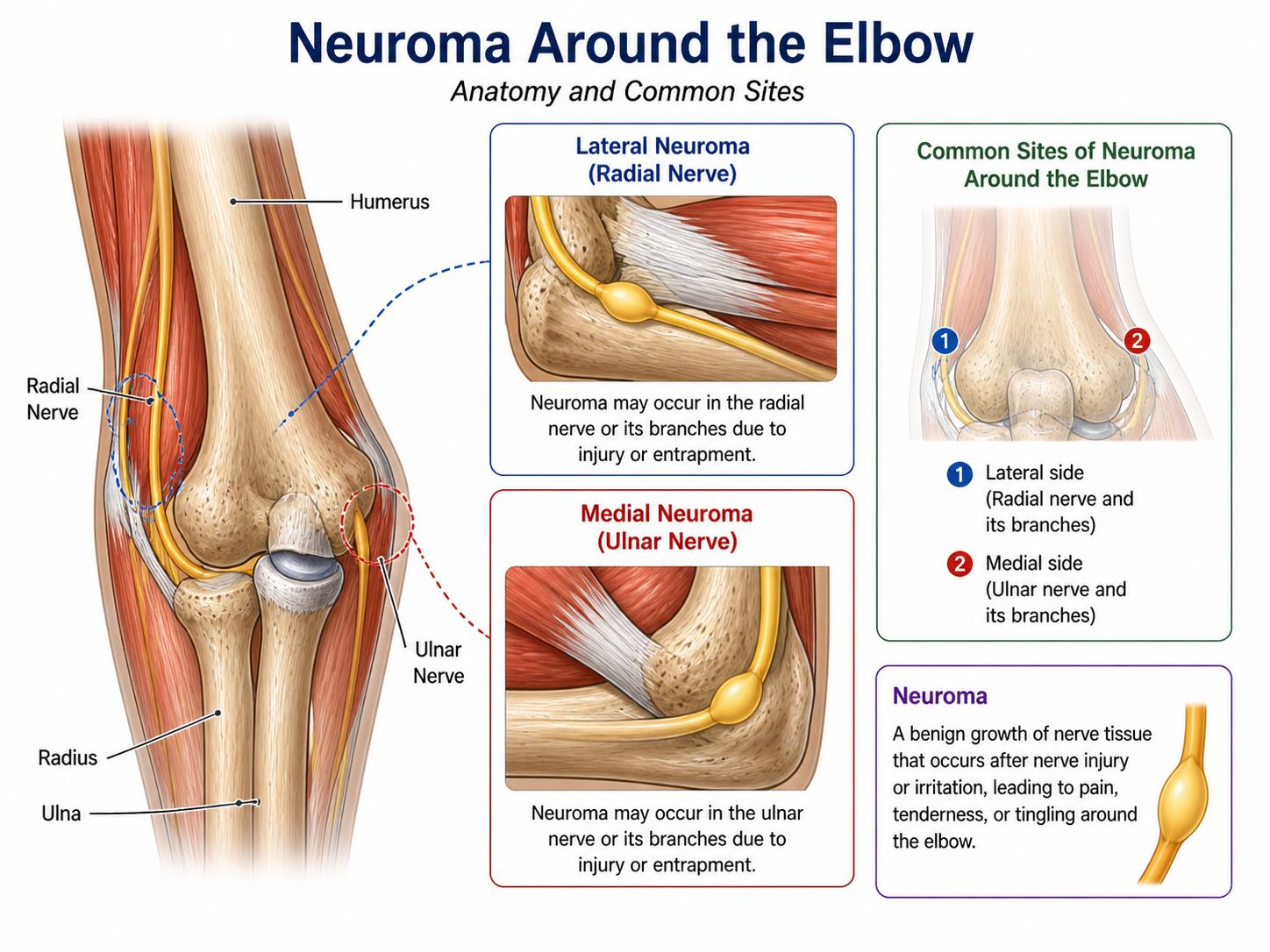
A neuroma is an abnormal, disorganised mass of nerve tissue that forms at the end of a severed or injured nerve. When a cutaneous (skin) nerve around the elbow is cut, stretched, or injured — during surgery, from trauma, or from a penetrating wound — the severed nerve end attempts to regenerate but forms a bulbous, painful scar-tissue nodule (neuroma) rather than successfully reconnecting to its target tissue.
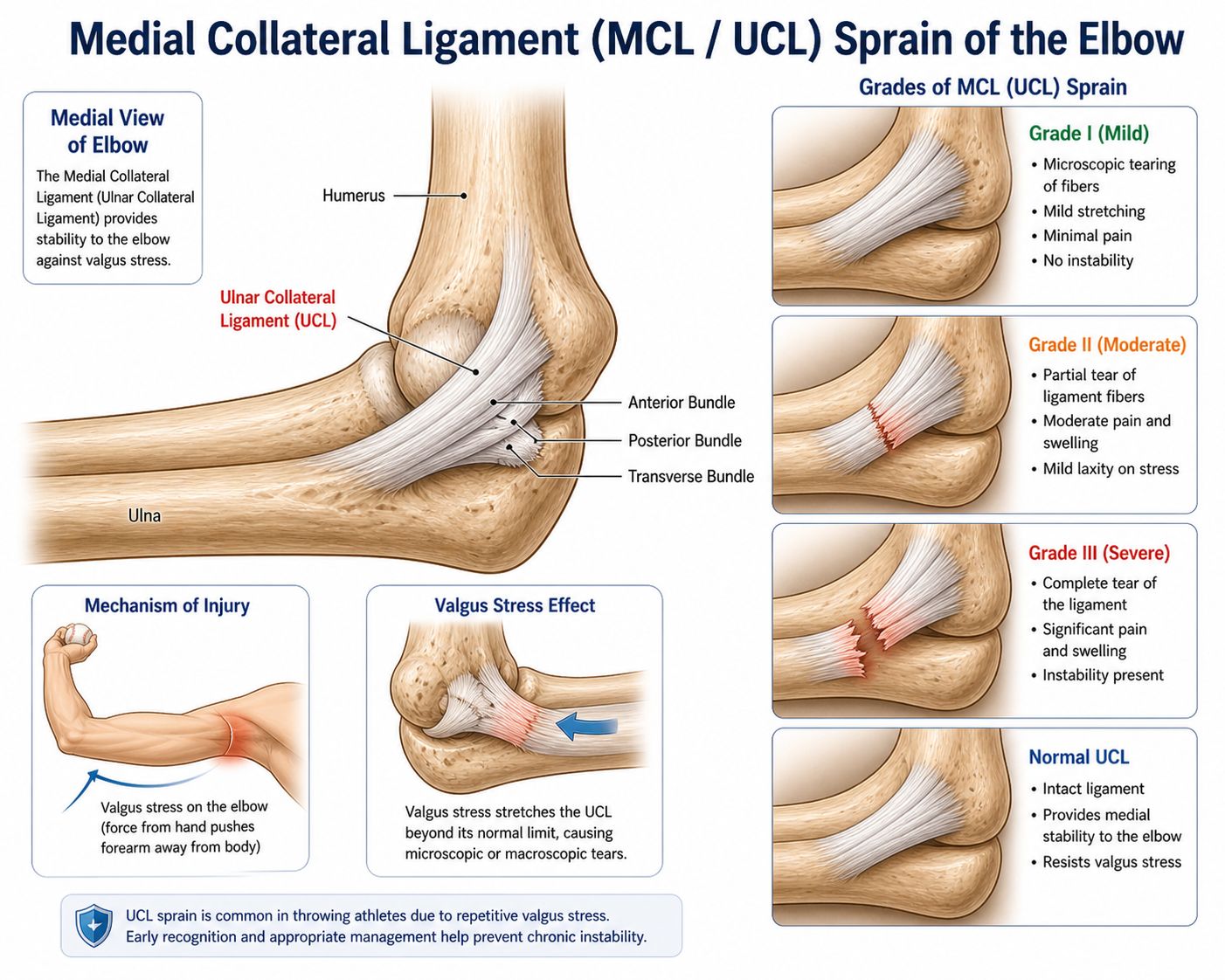
At the elbow, the medial antebrachial cutaneous nerve (MABC) is the most commonly injured cutaneous nerve — it is at risk during any surgery on the medial side of the elbow including cubital tunnel release, ulnar nerve transposition, medial epicondyle ORIF, and UCL reconstruction. Injury to this nerve causes a painful neuroma on the medial forearm that produces sharp, electric, or burning pain at the scar site, often with radiation along the medial forearm.
Neuromas are frequently overlooked as a cause of persistent post-operative or post-traumatic elbow pain because they are not detected on standard imaging. Careful clinical examination — identifying a focal tender point that reproduces symptoms with direct pressure or percussion (Tinel sign) — is the key diagnostic step.
Quick Facts | Details |
Also Known As | Medial Antebrachial Cutaneous Neuroma, MABC Neuroma, Cutaneous Nerve Neuroma — Elbow |
Affected Area | Medial antebrachial cutaneous nerve (MABC), lateral antebrachial cutaneous nerve (LABC), medial epicondyle cutaneous branches, and any cutaneous nerve in the region of prior elbow incisions |
Who It Affects | Adults following elbow surgery (cubital tunnel release, medial epicondyle fixation, UCL surgery), elbow trauma with nerve laceration, or local nerve injury from direct blows or injections |
Prevalence | Cutaneous nerve neuromas are an underrecognised cause of chronic post-operative or post-traumatic elbow pain; estimated to account for 5–10% of persistent pain following elbow surgery; medial antebrachial cutaneous nerve neuroma is the most common at the medial elbow |
Treatment | Desensitisation physiotherapy; alcohol or corticosteroid injection; surgical excision + nerve burial in muscle or bone; targeted muscle reinnervation (TMR) or regenerative peripheral nerve interface (RPNI) for refractory cases |
Causes & Risk Factors
- Surgical division of a cutaneous nerve — the MABC is at highest risk during medial elbow surgery; the LABC during lateral elbow approaches; any cutaneous nerve during elbow arthroscopy portal creation
- Traumatic nerve laceration — sharp injury, lacerations, deep abrasions over the medial or lateral elbow
- Penetrating injury — needle injury, glass or metal fragment embedding in the neurovascular plane
- Injection-related nerve injury — inadvertent intraneural corticosteroid injection
- Stretch injury — severe traction on a cutaneous nerve without complete division; partial injury neuromas
- Post-operative scar tethering — the nerve is not cut but becomes trapped and kinked in dense scar tissue following surgery, causing a pseudo-neuroma (traction neuroma)
- Incomplete neuroma: a nerve that was partially injured forms a spindle-shaped neuroma-in-continuity rather than a terminal end-bulb neuroma
Symptoms
- Focal point tenderness — a specific painful spot at the elbow or proximal forearm that is reproducibly tender on direct palpation; the hallmark of a neuroma
- Positive Tinel sign — tapping or percussion over the neuroma site produces a sharp, electric, or tingling sensation radiating along the nerve distribution
- Electric or burning pain — sharp shooting pain provoked by touching, bumping, or pressing the scar area; patients often guard the area
- Allodynia — light touch on the skin over the neuroma causes disproportionate pain
- Hyperaesthesia — heightened sensitivity to pain in the skin territory of the injured nerve
- Radiation of pain — along the medial forearm to the hand (MABC), or lateral forearm (LABC), depending on which nerve is involved
- History of prior surgery or trauma at the site — almost invariably present; new post-operative pain that worsens over weeks and is exquisitely focal should raise neuroma suspicion
How is it Diagnosed?
- Clinical examination — systematic palpation along the surgical scar or trauma site; identify the precise point of maximum tenderness and Tinel sign reproduction; map the sensory territory of the affected nerve
- Diagnostic local anaesthetic injection — injection of 1–2ml local anaesthetic directly at the tender nodule; complete temporary relief of the pain confirms the diagnosis of neuroma
- Ultrasound — high-resolution ultrasound may identify a hypoechoic fusiform nodule at the nerve end; useful for guiding injection and surgical planning; operator experience important
- MRI — limited but may show a focal nodule on high-resolution sequences; useful to exclude other pathology (scar tissue vs neuroma vs ganglion)
- Review of operative notes — determine which nerves were in the surgical field and whether any cutaneous nerve dissection was performed
Treatment Options
Treatment Type | Details |
Desensitisation Physiotherapy | First-line for all neuromas; progressive tactile stimulation programme to reduce allodynia; reduces hypersensitivity over 6–12 weeks; most effective in early/mild neuromas |
Corticosteroid Injection | Perineur al corticosteroid injection at the neuroma site (ultrasound-guided); reduces local inflammation and nerve excitability; temporary relief; may be repeated up to 3 times |
Alcohol Injection (Chemical Neurolysis) | Ultrasound-guided injection of 2–5% phenol or 50–80% alcohol into the neuroma; destroys the abnormal nerve tissue; effective in 60–70% of cases; risk of spread to adjacent nerves if not precisely placed |
Surgical Excision + Nerve Burial | Excision of the neuroma + transposition of the nerve end into a protected location (muscle belly or bone canal); burying the nerve end prevents re-formation of a painful terminal neuroma; most durable surgical treatment |
Targeted Muscle Reinnervation (TMR) | Modern technique; the cut nerve end is coapted to a small motor nerve branch to a nearby muscle; provides a distal target for the nerve to regenerate into; prevents neuroma formation and reduces neuroma pain; superior to simple burial in emerging evidence |
Regenerative Peripheral Nerve Interface (RPNI) | Small piece of denervated muscle wrapped around the nerve end; provides biological substrate for nerve regeneration; reduces neuroma pain; used in specialist peripheral nerve centres |
Neuromodulation | Spinal cord stimulation or peripheral nerve stimulation for refractory cases; provides central pain modulation without peripheral nerve manipulation; rarely needed |
Recovery & Rehabilitation
- Desensitisation physiotherapy: improvement over 6–12 weeks; continuation important even after other treatments
- After injection: temporary relief 4–12 weeks; repeat if effective; persistent relief uncommon from injections alone
- After surgical excision + burial: wound healing 2 weeks; return to normal activity 4–6 weeks; neuroma pain relief in 70–80%; risk of new neuroma formation at the burial site if not properly buried
- After TMR: longer recovery 3–6 months; the new motor nerve connection takes time to establish; pain reduction continues to improve over months
- Patient education: neuromas are challenging conditions; realistic expectations are important — complete pain elimination is not always achieved; significant pain reduction and functional improvement are realistic goals
Why choose Dr Senthilvelan?
Neuromas at the elbow require a systematic approach — from diagnosis by clinical examination and diagnostic injection, through to the selection of the most appropriate treatment. Dr Senthilvelan is experienced in the recognition and surgical management of cutaneous nerve neuromas, particularly the medial antebrachial cutaneous nerve, which is at risk during common medial elbow procedures.
Frequently Asked Questions
1. How do I know if my persistent elbow pain after surgery is from a neuroma?
The hallmark signs of a neuroma are: a specific, reproducible tender spot at or near the surgical scar; an electric or shooting sensation when that spot is touched or tapped (positive Tinel sign); and a burning or sharp quality to the pain rather than a deep aching. A diagnostic injection of local anaesthetic directly at the tender spot that temporarily eliminates the pain completely is the most reliable confirmation. If this is positive, it both confirms the diagnosis and predicts whether surgical treatment is likely to help.
2. Can a neuroma form even if the nerve was not cut — just stretched?
Yes — partial nerve injuries (stretch injuries, crush injuries, or partial lacerations) can form spindle-shaped neuromas-in-continuity, where the disorganised nerve tissue forms within the intact nerve sheath rather than at a cut end. These tend to be less focal than terminal neuromas but produce similar symptoms. They are identified on high-resolution ultrasound as a focal fusiform swelling within the nerve. Treatment principles are similar, but surgery must carefully preserve any functioning nerve fibres within the neuroma.
3. Will the neuroma come back after surgery?
Standard surgical excision and burial of the nerve end in muscle provides good relief in 70–80% of patients but carries a risk of recurrence — the nerve can re-grow out of the muscle belly and form a new terminal neuroma. Newer techniques such as targeted muscle reinnervation (TMR) provide a permanent target for the nerve to grow into, which significantly reduces recurrence. At centres where TMR is available, it is now preferred over simple burial for most terminal neuromas.
4. What is the medial antebrachial cutaneous nerve and why is it commonly injured?
The medial antebrachial cutaneous nerve (MABC) is a sensory nerve that supplies the skin of the medial forearm from the elbow to the wrist. It arises from the medial cord of the brachial plexus and travels on the medial side of the arm, passing close to the medial epicondyle as it enters the forearm. During any surgery on the medial side of the elbow — cubital tunnel release, UCL reconstruction, medial epicondyle ORIF — the MABC crosses the surgical field and can be inadvertently cut or tethered. This is the most common nerve injured at the elbow during elbow surgery.
5. Is physiotherapy alone enough to treat a neuroma?
For mild neuromas, particularly those that have developed recently (within 3–6 months) or represent desensitised but intact nerves rather than true terminal neuromas, a dedicated desensitisation physiotherapy programme can be very effective. The programme involves progressively stimulating the hypersensitive skin with different textures, pressures, and temperatures to reduce the central sensitisation. For established terminal neuromas with a positive Tinel sign and clear focal nodule, physiotherapy alone is rarely curative but remains an important part of the overall management alongside injection or surgical treatment.