Overview
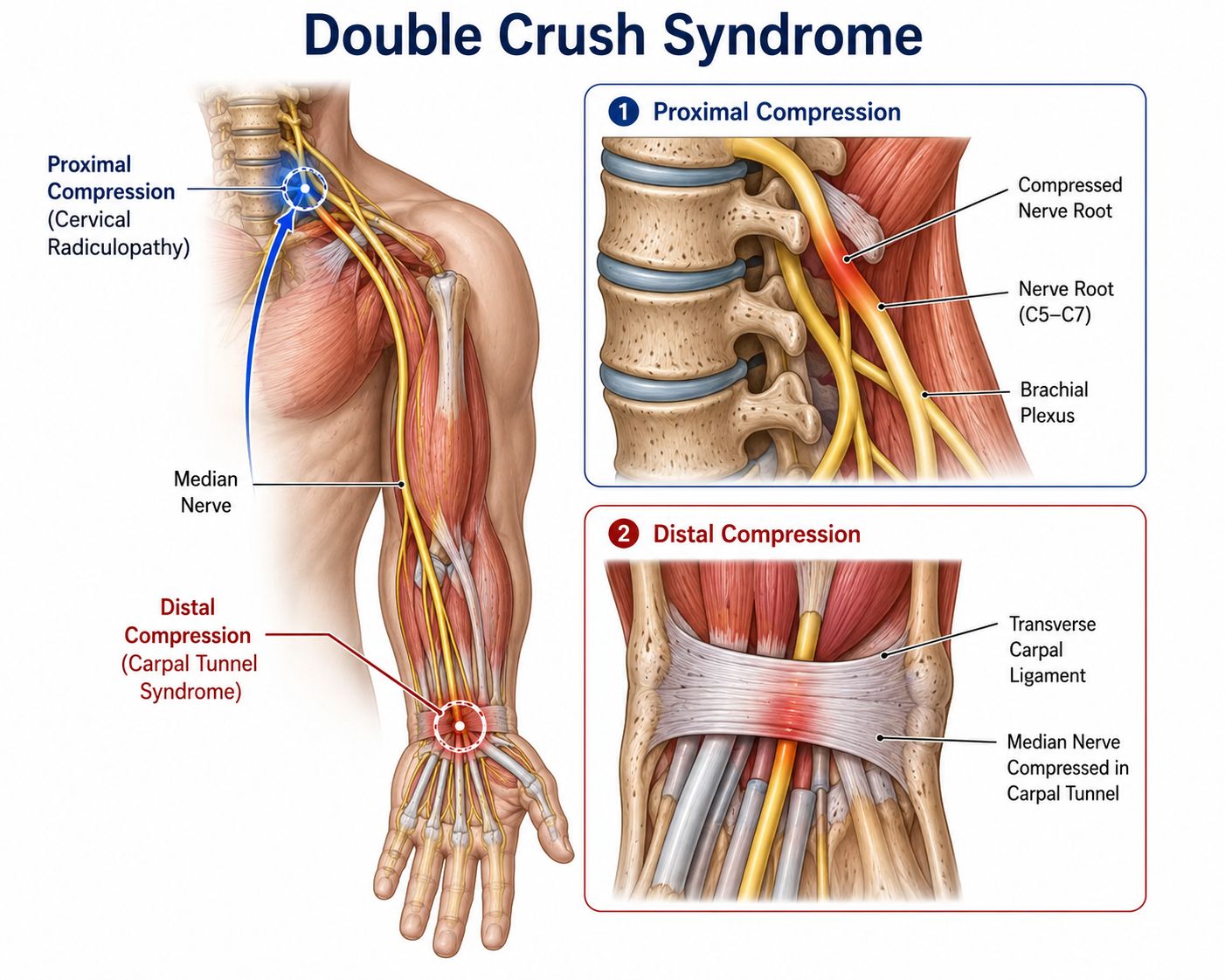
The double crush syndrome, first described by Upton and McComas in 1973, proposes that a nerve that is already compressed or irritated at one level (e.g. the cervical spine) becomes hypersensitive and more vulnerable to additional compression at a second, more distal level (e.g. the elbow). The two levels of compression act together to produce symptoms that are more severe than either would cause in isolation — and, critically, decompressing only one level often fails to resolve symptoms.
The physiological basis is that proximal nerve compression (at the cervical foramen) impairs axoplasmic flow — the movement of proteins and nutrients down the nerve axon. A nerve that is already metabolically stressed by proximal compression has a reduced capacity to tolerate additional distal compression at a normal anatomical tight-point. Thus, a mild cubital tunnel compression that would normally be subclinical becomes symptomatic in the context of cervical radiculopathy.
The clinical importance of double crush syndrome lies in understanding why some patients do not improve fully after technically successful elbow decompression surgery — the answer is that the proximal level was never addressed. Systematic pre-operative assessment for proximal compression is essential before committing to peripheral nerve surgery.
Quick Facts | Details |
Also Known As | Double Crush Phenomenon, Dual-Level Nerve Compression, Multiple Crush Syndrome |
Affected Area | Most commonly: cervical spine (C6–C8 disc herniation or foraminal stenosis) + elbow (cubital tunnel or radial tunnel); can also involve the wrist as a third level |
Who It Affects | Adults of any age; more common in patients with cervical spondylosis, degenerative disc disease, or cervical canal stenosis who also perform occupations or activities predisposing to peripheral nerve compression |
Prevalence | Underdiagnosed; estimated to contribute to 10–20% of cases of peripheral nerve entrapment at the elbow that fail to improve after technically successful decompression; important explanation for persistent symptoms after correct elbow surgery |
Treatment | Identify both compression levels with EMG and imaging; treat the proximal (cervical) level first; reassess peripheral (elbow) symptoms after 3 months; decompression of elbow if cervical treatment insufficient |
Causes & Risk Factors
- Cervical disc herniation (C6–C7 or C7–T1) — the most common proximal level; compresses the C7 or C8 nerve root which contributes to the ulnar or median nerve distally
- Cervical foraminal stenosis from spondylosis — degenerative narrowing of the neural foramina; common in middle-aged and elderly adults
- Thoracic outlet syndrome (TOS) — compression at the thoracic outlet as a second proximal level (triple crush: cervical + TOS + cubital)
- Cubital tunnel syndrome — the most common distal level for a double crush pattern; ulnar nerve compressed at the elbow in the context of C8–T1 cervical involvement
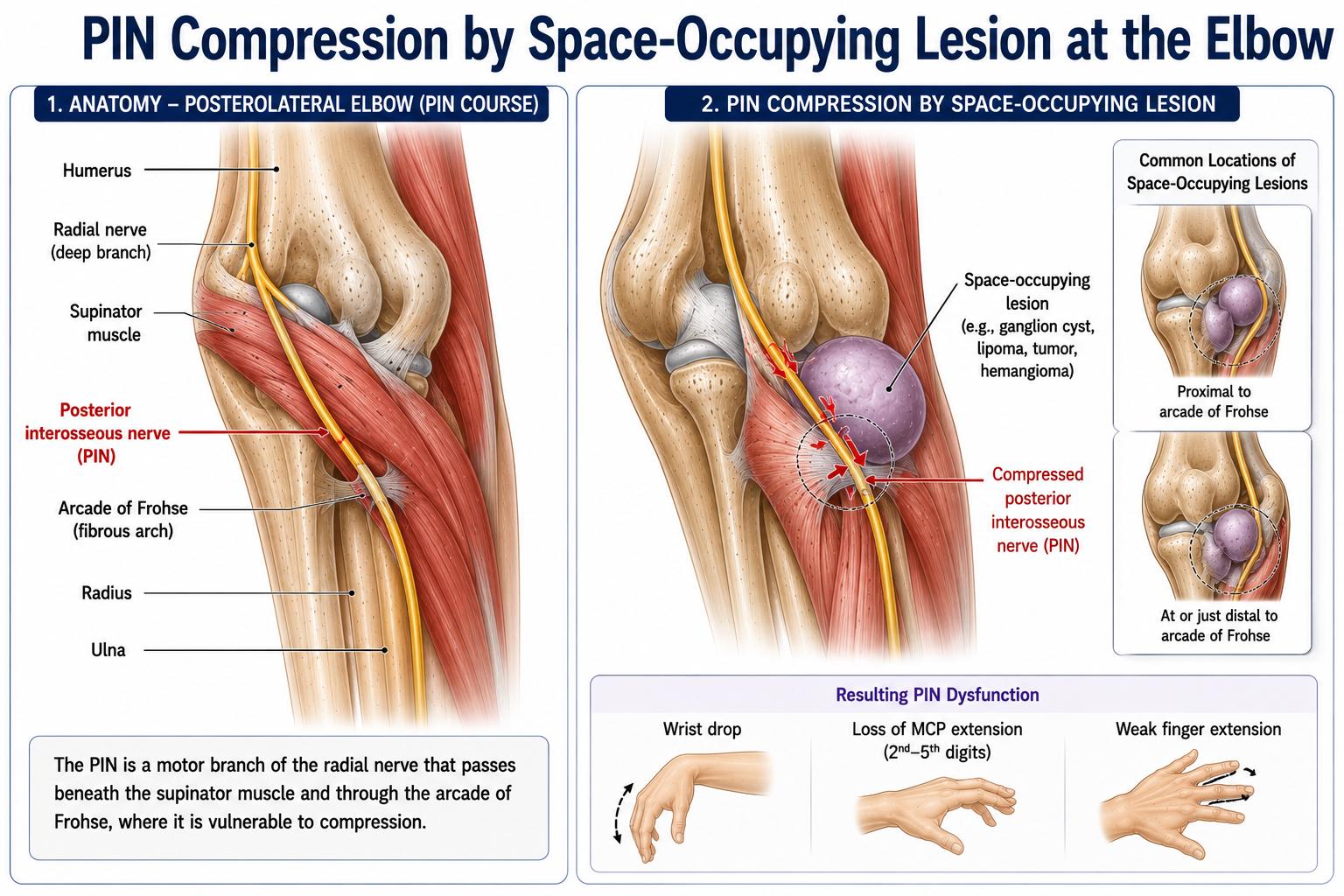
- Radial tunnel syndrome — radial nerve compressed at the arcade of Frohse in the context of C7 radiculopathy
- Pronator syndrome + carpal tunnel — median nerve compressed at two distal levels (double distal crush)
- Occupational and postural factors — sedentary desk work with both neck flexion and elbow flexion maintained for hours predisposes to compression at both levels simultaneously
Symptoms
- Diffuse arm symptoms — tingling, numbness, aching, and weakness that is poorly localised and does not conform neatly to a single peripheral nerve or single dermatomal distribution
- Symptoms at multiple levels — neck and shoulder aching combined with elbow and hand tingling; involvement of more skin territory than expected from a single peripheral nerve
- Persistent symptoms despite previous elbow surgery — a patient who had cubital tunnel release with no improvement, or improvement followed by recurrence, may have an unaddressed proximal level
- Neck pain and stiffness — radiation into the shoulder, arm, and forearm; provoked by neck movement
- Weakness in multiple muscle groups — involving muscles supplied by more than one peripheral nerve, suggesting root-level pathology
- Bilateral symptoms — cervical radiculopathy affecting both arms can present bilaterally; bilateral cubital tunnel syndrome is common in this context
- Worsening with sustained posture — symptoms provoked by prolonged sitting at a desk with neck flexion and elbows bent for extended periods
How is it Diagnosed?
- Detailed history — prior elbow or wrist decompression that failed; prior cervical treatment; occupational history; bilateral symptoms
- Clinical examination — full cervical spine assessment (Spurling test, neural tension tests, dermatomal mapping); full peripheral nerve examination at the elbow and wrist; identify which level(s) reproduce symptoms
- EMG/Nerve conduction studies — ESSENTIAL; identifies the site(s) of conduction abnormality; may show abnormalities at both the cervical root (EMG changes in paraspinal muscles) and the peripheral nerve; helps quantify the relative contribution of each level
- MRI cervical spine — identifies disc herniation, foraminal stenosis, or cord compression at the proximal level
- MRI or ultrasound of the peripheral nerve — confirms entrapment at the elbow level
- Diagnostic nerve block — selective proximal (cervical or thoracic outlet) nerve block; if this relieves the distal (elbow/hand) symptoms, it confirms the proximal level is driving the distal vulnerability

Treatment Options
Treatment Type | Details |
Treat the Proximal Level First | Standard principle: address cervical pathology (physiotherapy, cervical epidural, or cervical surgery) before peripheral decompression; give 3 months after cervical treatment to assess peripheral improvement |
Cervical Physiotherapy | Manual therapy, cervical traction, and postural correction for disc-related cervical radiculopathy; effective for mild-moderate cervical compression; 60–70% improvement in radicular symptoms |
Cervical Epidural Steroid Injection | For cervical disc herniation with radiculopathy not responding to physiotherapy; provides 6–12 weeks of relief; may be sufficient to unmask whether the elbow compression is significant independently |
Cervical Surgery | ACDF (anterior cervical discectomy and fusion) or foraminotomy for cervical radiculopathy with significant motor deficit or failed conservative treatment; performed by the spine team; Dr Senthilvelan coordinates this referral |
Elbow Decompression (After Cervical Treatment) | If significant peripheral symptoms persist after cervical treatment, elbow decompression is performed; cubital tunnel release with or without transposition; radial tunnel decompression as appropriate; expected outcomes are better when the proximal level has been addressed |
Ergonomic Optimisation | Eliminate sustained neck flexion and elbow flexion simultaneously; sit-stand workstations; regular posture breaks; combined with physiotherapy at both levels |
Recovery & Rehabilitation
- Double crush resolution is slower than single-level decompression — recovery occurs in stages as each level is addressed
- After cervical treatment: allow 3 months to assess peripheral improvement before proceeding to elbow surgery
- After elbow decompression: nerve recovery timeline same as single-level (see Cubital Tunnel, Condition 23)
- Combined recovery: most patients see significant symptom improvement but complete resolution may take 12–18 months
- Ergonomic changes are permanent modifications — they prevent recurrence at both levels and are maintained long-term
- EMG at 6 months after both levels treated to objectively document nerve recovery
Why choose Dr Senthilvelan?
Understanding double crush syndrome is what separates a systematic upper limb specialist from someone who treats each peripheral nerve in isolation. Dr Senthilvelan’s comprehensive upper limb assessment approach routinely screens for proximal cervical involvement before any peripheral nerve surgery, ensuring that patients receive the right treatment at the right level in the right sequence.
Frequently Asked Questions
1. I had cubital tunnel surgery 6 months ago and my hand is still tingling — could double crush be the reason?
Yes — this is a classic presentation. If your elbow surgery was performed correctly but symptoms have not resolved, the most important question is whether there is a proximal level of compression — typically cervical disc disease or foraminal stenosis — that was not identified before surgery. An MRI of the cervical spine and a repeat EMG/NCS (which can compare pre- and post-operative nerve function at both the elbow and the cervical level) will clarify this. If cervical compression is found, treatment of the cervical level often leads to the improvement that the elbow surgery alone did not achieve.
2. How does cervical spine disease cause problems at the elbow?
The peripheral nerves in the arm are extensions of spinal nerve roots that originate in the cervical spine. The ulnar nerve, for example, receives contributions from the C8 and T1 nerve roots. If these roots are compressed in the cervical foramina by a disc herniation or arthritic change, the entire nerve is placed under metabolic stress — reduced blood flow, impaired axoplasmic transport, and increased susceptibility to mechanical compression at any point along its course. This explains why a mild anatomical narrowing at the cubital tunnel, which would be entirely tolerated in a healthy nerve, can cause significant symptoms when the nerve is already stressed proximally.
3. If I have double crush, which level should be treated first?
The standard principle is to treat the proximal (cervical) level first and then reassess the distal (elbow) symptoms after 3 months. Treating the proximal level often reduces the distal nerve’s vulnerability, and elbow symptoms may improve substantially without peripheral surgery. If significant elbow symptoms remain after adequate cervical treatment, peripheral decompression is then performed. Treating the elbow first while leaving the cervical level unaddressed is the most common reason for failed elbow surgery in double crush cases.
4. My symptoms are only in one arm but my MRI shows disc disease at several cervical levels — how do we know which level is causing the problem?
Determining the clinically significant level among several radiological abnormalities requires correlation with the clinical examination, dermatomal sensory mapping, and EMG findings. EMG is particularly valuable — it can show active denervation changes in specific muscles that confirm which nerve root is involved at the segmental level. A selective nerve root block (injection of local anaesthetic at a specific cervical foramen) can also confirm which disc level is the pain generator. Not all radiological disc disease requires treatment — only the level that is clinically and electrophysiologically confirmed.
5. Can double crush syndrome involve three levels simultaneously?
Yes — triple crush syndrome has been described, typically involving the cervical spine, the thoracic outlet, and the elbow (or wrist) simultaneously. This pattern is particularly seen in patients with sedentary occupations who sit for long periods with neck flexion, rounded shoulders, and elbows bent. Each level individually might be subclinical, but together they produce significant symptoms. Management requires addressing all three levels — usually in a proximal-to-distal sequence — combined with comprehensive ergonomic and postural rehabilitation.