Overview
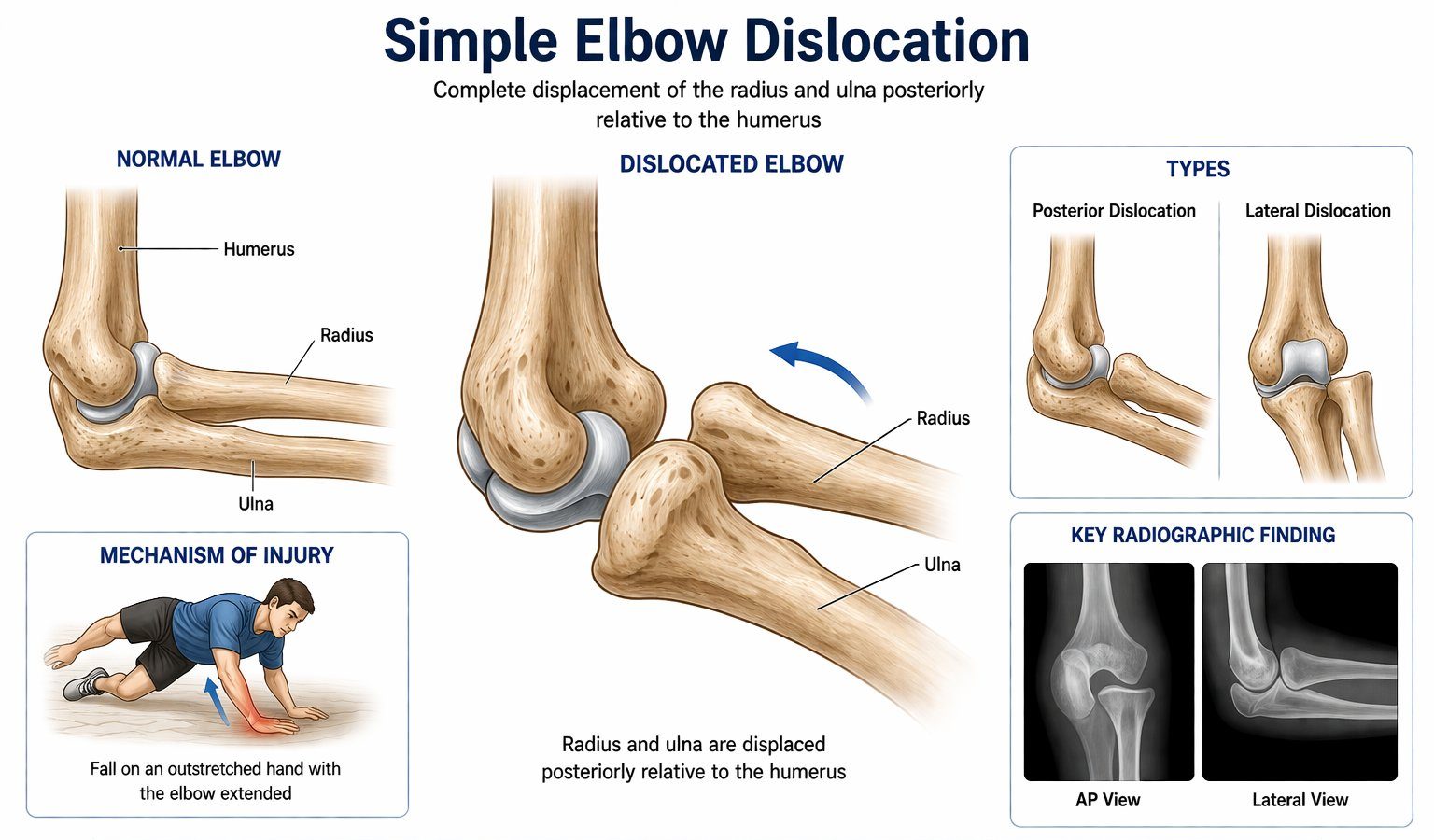
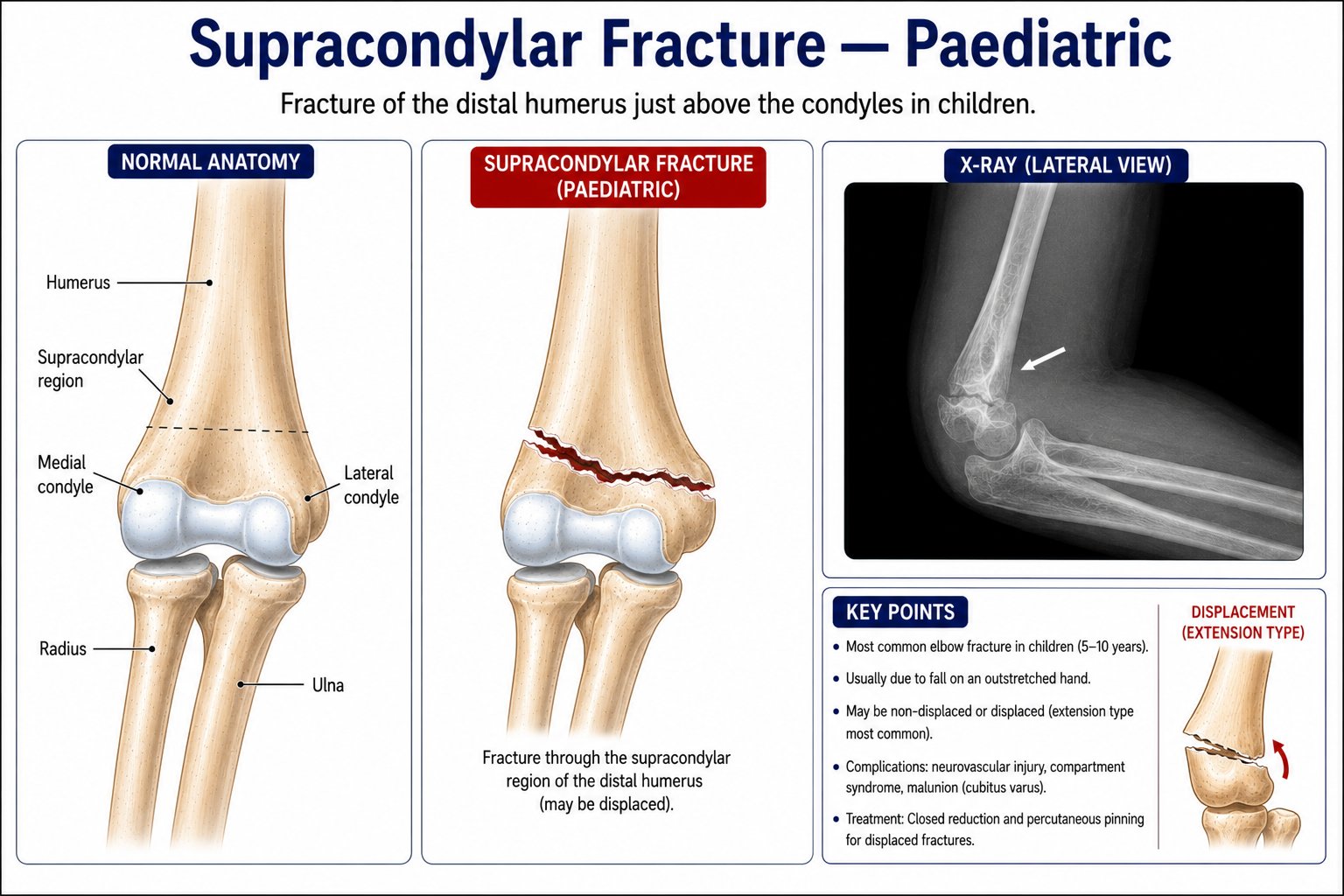
Supracondylar fractures of the humerus are the most common paediatric elbow fracture and represent one of the most important orthopaedic emergencies in children. They occur through the thin supracondylar region of the distal humerus — the waist above the condyles — most commonly from a fall onto an outstretched hand in extension (extension-type fracture, accounting for 97–98% of cases). The distal fragment displaces posteriorly relative to the proximal shaft.
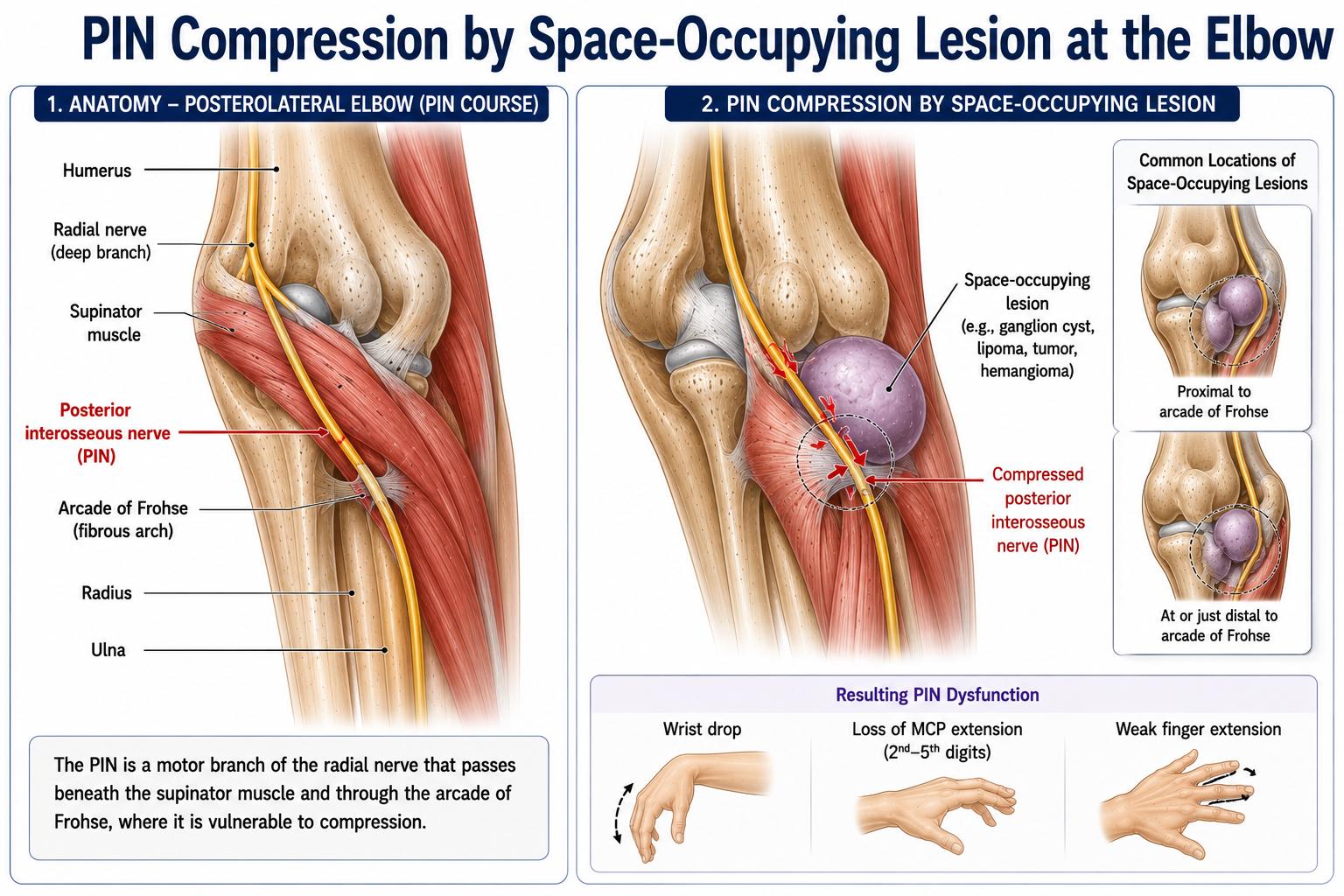
The Gartland classification defines management: Type I (non-displaced — cast only), Type II (angulated with intact posterior cortical hinge — reduction + K-wires), Type III (completely displaced, no cortical contact — urgent CRPP), and Type IV (multidirectional instability — rare, highest instability). The most feared complication is neurovascular compromise — the anterior interosseous nerve (AIN) and radial nerve are most commonly injured by the sharp proximal fragment; vascular injury to the brachial artery can cause acute ischaemia or the devastating Volkmann’s ischaemic contracture.
Every child presenting with a supracondylar fracture requires a systematic neurovascular assessment before and after any treatment. The “pink pulseless hand” — a hand that is well-perfused (pink, warm, good capillary refill) but without a palpable radial pulse — is a specific and important scenario: the brachial artery is typically kinked around the fracture but not completely interrupted; once the fracture is reduced, the pulse usually returns. Absent pulse with poor perfusion requires urgent vascular exploration.
Quick Facts | Details |
Also Known As | Supracondylar Humerus Fracture Child, Transcondylar Fracture, Distal Humerus Fracture Child |
Affected Area | Supracondylar region of the distal humerus — the thin, flat area just proximal to the condyles; the weakest part of the distal humerus in children |
Who It Affects | Children aged 5–8 years; the peak age of occurrence coincides with the period of maximal ligamentous laxity and the hyperextension tendency of the young elbow; accounts for approximately 55–65% of all paediatric elbow fractures |
Prevalence | The most common paediatric elbow fracture and the most common fracture requiring surgery in children; incidence approximately 3–4 per 10,000 children per year; Gartland Type III fractures represent a true orthopaedic emergency |
Treatment | Gartland I (non-displaced): above-elbow cast 3–4 weeks; Gartland II (angulated, hinge intact): closed reduction + percutaneous K-wires; Gartland III/IV (completely displaced): urgent CRPP under GA; neurovascular assessment mandatory before and after every intervention |
Causes & Risk Factors
- Fall onto an outstretched hyperextended arm — the classic mechanism; the olecranon locks in the olecranon fossa, the triceps creates a posterior force, and the supracondylar region fails
- Fall from height — playground equipment (monkey bars, swings); the most common specific mechanism
- Sports injuries — gymnastics, cycling, trampolining
- Anatomical predisposition — the thin supracondylar region in children aged 5–8 years is structurally weak; children in this age group also have marked ligamentous laxity
Symptoms
- Acute elbow pain — immediately following the fall; the child cries and will not use the arm
- Significant swelling — rapidly progressive; the elbow may be grossly distorted in Type III fractures
- Deformity — in Type III fractures, the elbow appears S-shaped or the arm is shortened; the proximal fragment may tent the anterior skin
- Refusal to move — the arm is held still in slight elbow flexion
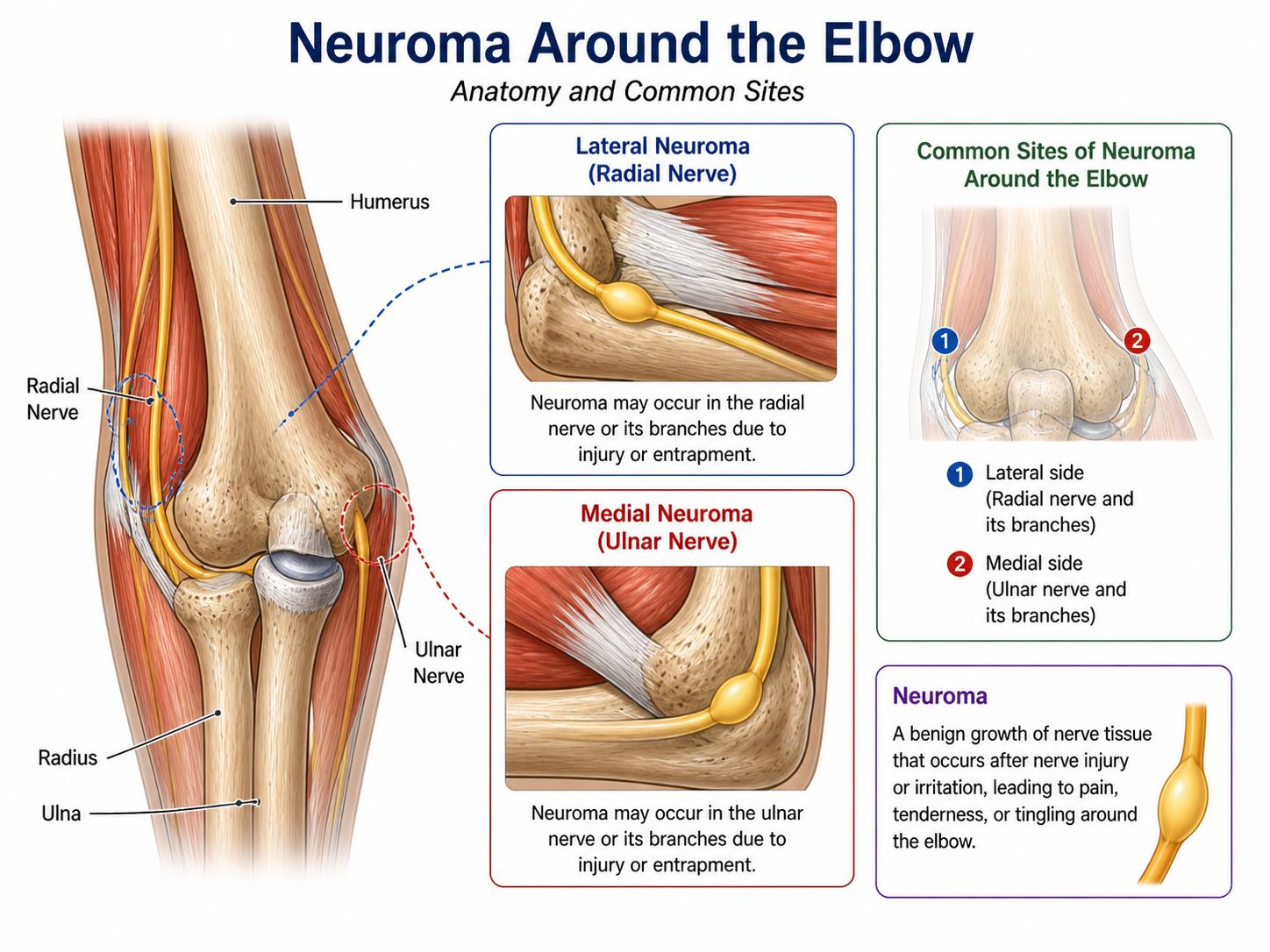
- NEUROVASCULAR ASSESSMENT (mandatory and repeated): radial pulse (present/absent/diminished); hand perfusion (colour, warmth, capillary refill); anterior interosseous nerve (FPL — thumb IP flexion, FDP index — index DIP flexion); radial nerve (wrist extension); median nerve sensation (thumb/index pulp); ulnar nerve (little finger sensation)
- Anterior skin dimple or pucker — indicates proximal fragment has buttonholed through the brachialis; implies difficult closed reduction
How is it Diagnosed?
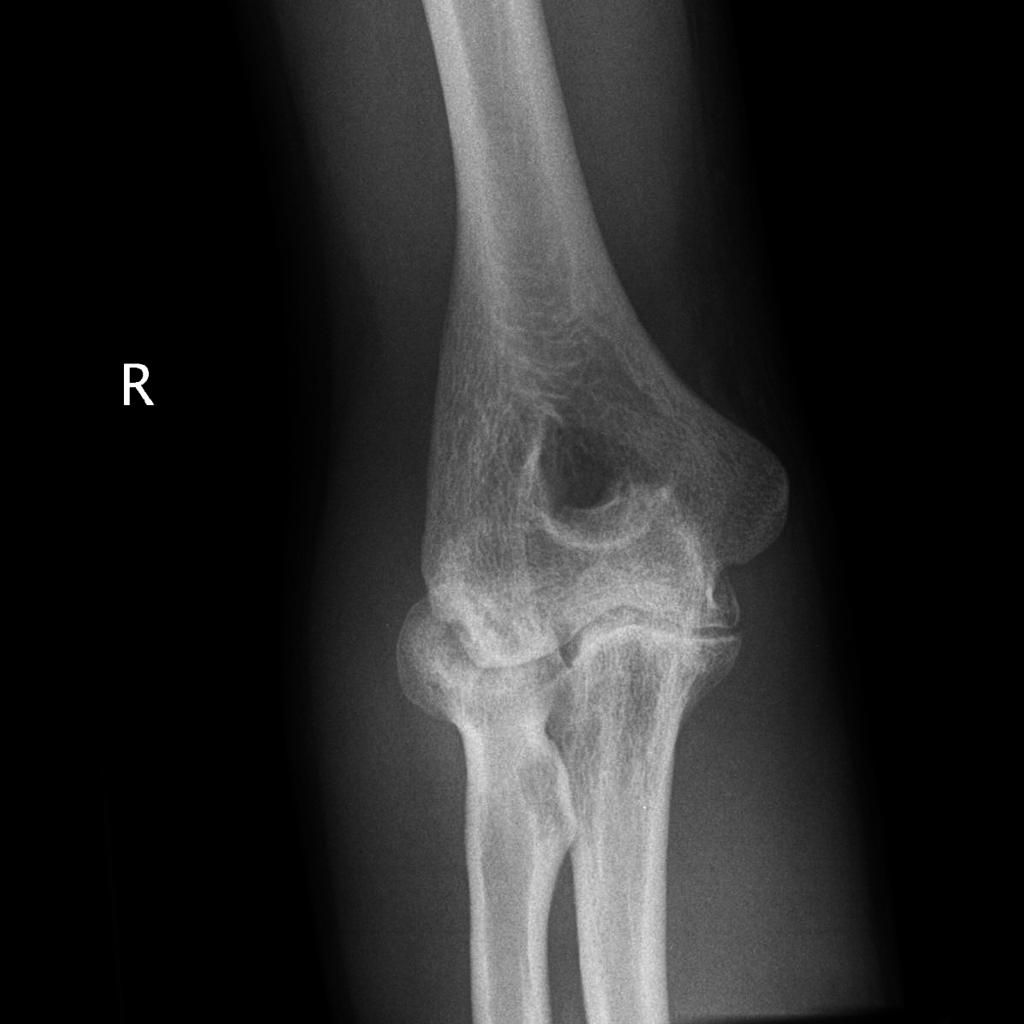
- Plain X-rays (AP + lateral) — Gartland classification on lateral view: Type I (no displacement, fat pad sign only), Type II (posterior hinge intact, distal fragment angulated), Type III (complete displacement)
- Anterior humeral line (on lateral X-ray) — normal: passes through the middle third of the capitellum; in Type II/III fractures, this line passes through the anterior third or misses the capitellum entirely — confirms posterior displacement
- Baumann’s angle (on AP X-ray) — the angle between the axis of the lateral condyle physis and the humeral shaft; normal ~72°; asymmetry vs the normal side indicates malreduction or varus tilt
- CT scan — not routinely needed; used for complex patterns or if reduction adequacy is uncertain
- Vascular assessment — if absent pulse: urgent reduction; if pulse still absent post-reduction: urgent vascular surgery consultation

Treatment Options
Treatment Type | Details |
Above-Elbow Cast — Gartland I | Non-displaced: moulded above-elbow cast in 90° flexion and slight pronation; 3–4 weeks; weekly X-ray to confirm no displacement |
Closed Reduction + Percutaneous K-Wires — Gartland II | Under general anaesthesia; standard Dunlop-Wilkins closed reduction technique (traction, correct rotation, flex to 90° in pronation); confirm on fluoroscopy (AP + lateral + AP with internal rotation for Baumann’s angle); 2–3 smooth K-wires (crossed medial-lateral or 2 lateral); above-elbow cast 3–4 weeks; K-wires removed at 3–4 weeks in clinic |
Urgent CRPP — Gartland III/IV | Surgical emergency; GA; closed reduction under image intensifier; crossed K-wires (2 lateral + 1 medial) or 3 lateral K-wires; confirm reduction on AP (Baumann’s angle symmetric), lateral (anterior humeral line through middle third capitellum), and internal rotation AP; above-elbow cast; post-operative neurovascular check in recovery |
Open Reduction (Failed Closed) | Required in approximately 10% of Type III fractures when: skin buttonholed by proximal fragment; open fracture; failed closed reduction (neurovascular structures interposed); anterior approach for proximal fragment entrapment |
Vascular Emergency Management | Absent pulse + poor perfusion post-reduction: URGENT vascular surgery consultation; brachial artery exploration; fasciotomy if compartment syndrome; never leave a poorly perfused hand in a child after fracture reduction — immediate action required |
Medial K-Wire Technique Note | If a medial K-wire is used: the ulnar nerve must be palpated or identified to avoid inadvertent injury; some surgeons use only 2–3 lateral K-wires to avoid medial nerve risk entirely — equivalent stability in most fractures |
Recovery & Rehabilitation
- Above-elbow cast for 3–4 weeks regardless of fixation method
- K-wires removed at 3–4 weeks as an outpatient; no anaesthetic required in cooperative children
- ROM recovery: typically rapid in children — most achieve full ROM within 4–8 weeks of cast removal
- Return to sport: 6–8 weeks after K-wire removal; contact sport 3 months
- Cubitus varus (gunstock deformity): the most common malunion complication from malreduced Gartland III fractures; cosmetically apparent; may require corrective osteotomy if significant
- Nerve injuries: most AIN/radial/median nerve injuries recover spontaneously within 3 months; persistent deficit beyond 3 months requires EMG and specialist review
- Volkmann’s ischaemic contracture: devastating complication from missed vascular injury; prevented by vigilant neurovascular monitoring and prompt action
Why choose Dr Senthilvelan?
Supracondylar fractures in children require urgency, experience, and systematic neurovascular assessment. Dr Senthilvelan performs CRPP for all Gartland II–IV fractures under fluoroscopic guidance with meticulous attention to reduction quality (Baumann’s angle, anterior humeral line) and post-operative neurovascular monitoring — the twin pillars of safe outcomes in this injury.
Frequently Asked Questions
1. My child fell and their elbow is very swollen — is this a supracondylar fracture?
Significant elbow swelling after a fall in a child aged 5–10 years should always raise suspicion of a supracondylar fracture — it is the most common paediatric elbow fracture. Other important signs are: the child refusing to move the arm, crying continuously, and the characteristic held position of slight elbow flexion. An X-ray of the elbow including a true lateral view is essential. If the X-ray shows a fat pad sign (a lucent triangle of displaced fat behind the humerus) without a visible fracture, an occult fracture should be suspected and the arm treated as fractured.
2. What does "pink pulseless hand" mean and how is it managed?
A ‘pink pulseless hand’ describes a hand that appears well-perfused (warm, pink, good capillary refill) but does not have a palpable radial pulse. This specific scenario in supracondylar fractures means the brachial artery is kinked by the displaced fracture but not completely torn. The standard management is: proceed to urgent closed reduction and K-wire fixation. Once the fracture is reduced, the kinked artery typically straightens and the pulse returns — this occurs in approximately 85% of pink pulseless hands. If the pulse does not return after reduction, vascular surgical exploration is arranged urgently.
3. Why are K-wires used instead of screws in a child's elbow?
Smooth K-wires (thin metal pins) are used rather than screws in paediatric supracondylar fractures for several reasons: they can be inserted through intact skin (percutaneous) avoiding a surgical incision; they are easily removed in the outpatient clinic without anaesthesia once the fracture has healed at 3–4 weeks; they do not cross the active growth plates of the distal humerus (which could injure growth and cause deformity); and they are sufficient for the 3–4 weeks of protected immobilisation needed for healing in children.
4. What is cubitus varus (gunstock deformity) and how is it prevented?
Cubitus varus is a loss of the normal valgus carrying angle of the elbow, causing the arm to angle inward (giving the forearm a ‘gun-stock’ appearance). It is the most common malunion complication after supracondylar fractures and results from inadequate reduction — specifically leaving a medial tilt (varus) of the distal fragment. It is prevented by achieving and confirming a symmetric Baumann’s angle on the AP fluoroscopy view during surgery. If significant cubitus varus develops after healing, a corrective osteotomy of the lateral condyle (lateral closing-wedge osteotomy) can correct the deformity.
5. My child had surgery for a supracondylar fracture and now cannot extend their elbow normally — is this permanent?
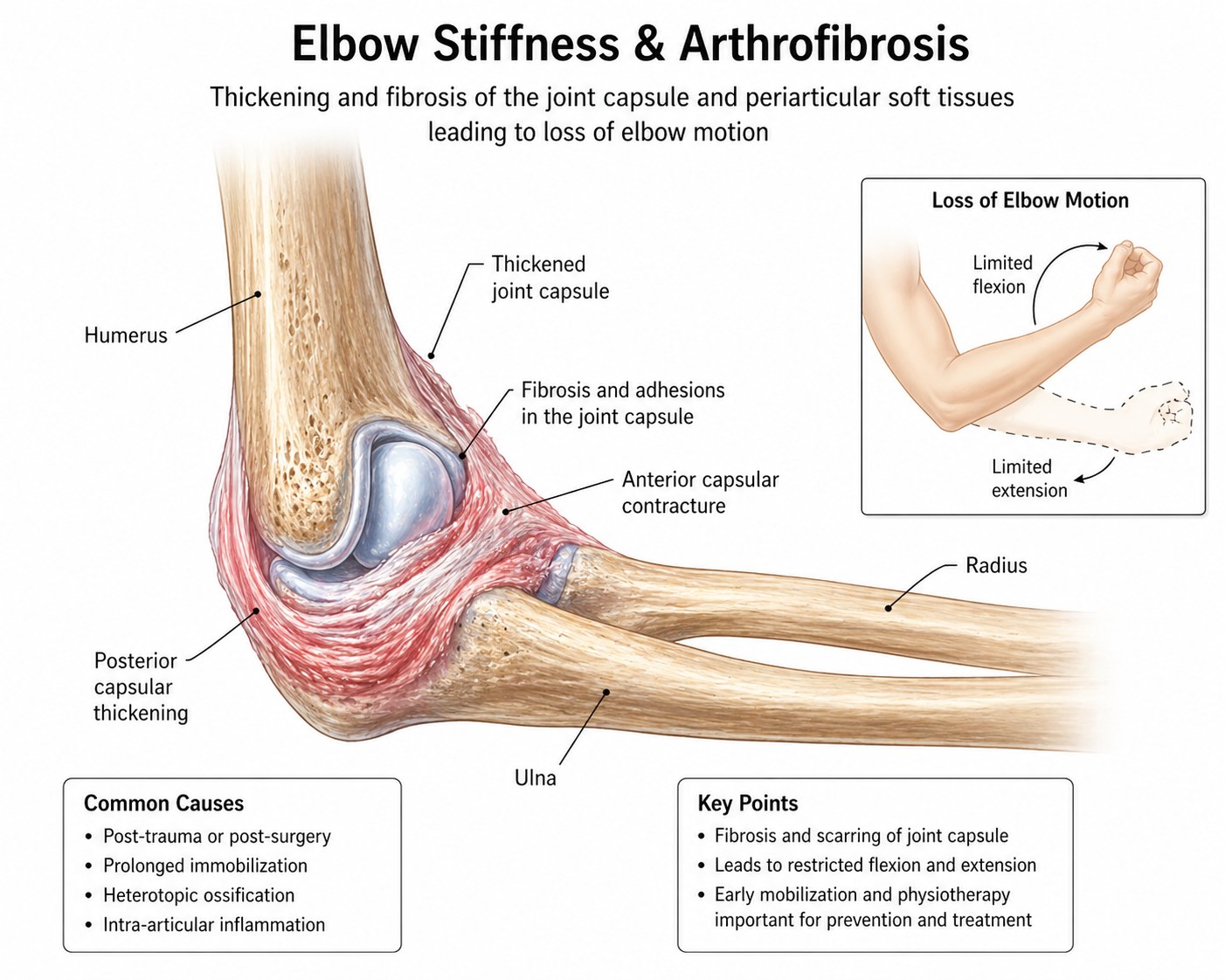
Mild loss of full extension (5–10°) is a common temporary finding after supracondylar fracture fixation and typically resolves completely with physiotherapy over 4–8 weeks. Children’s elbows are remarkably good at recovering range of motion compared to adults. Persistent loss of extension beyond 3 months is less common and may require physiotherapy or, in rare cases, a dynamic extension splint. True permanent stiffness is uncommon when the fracture was well-reduced and mobilisation began promptly after K-wire removal.