Overview
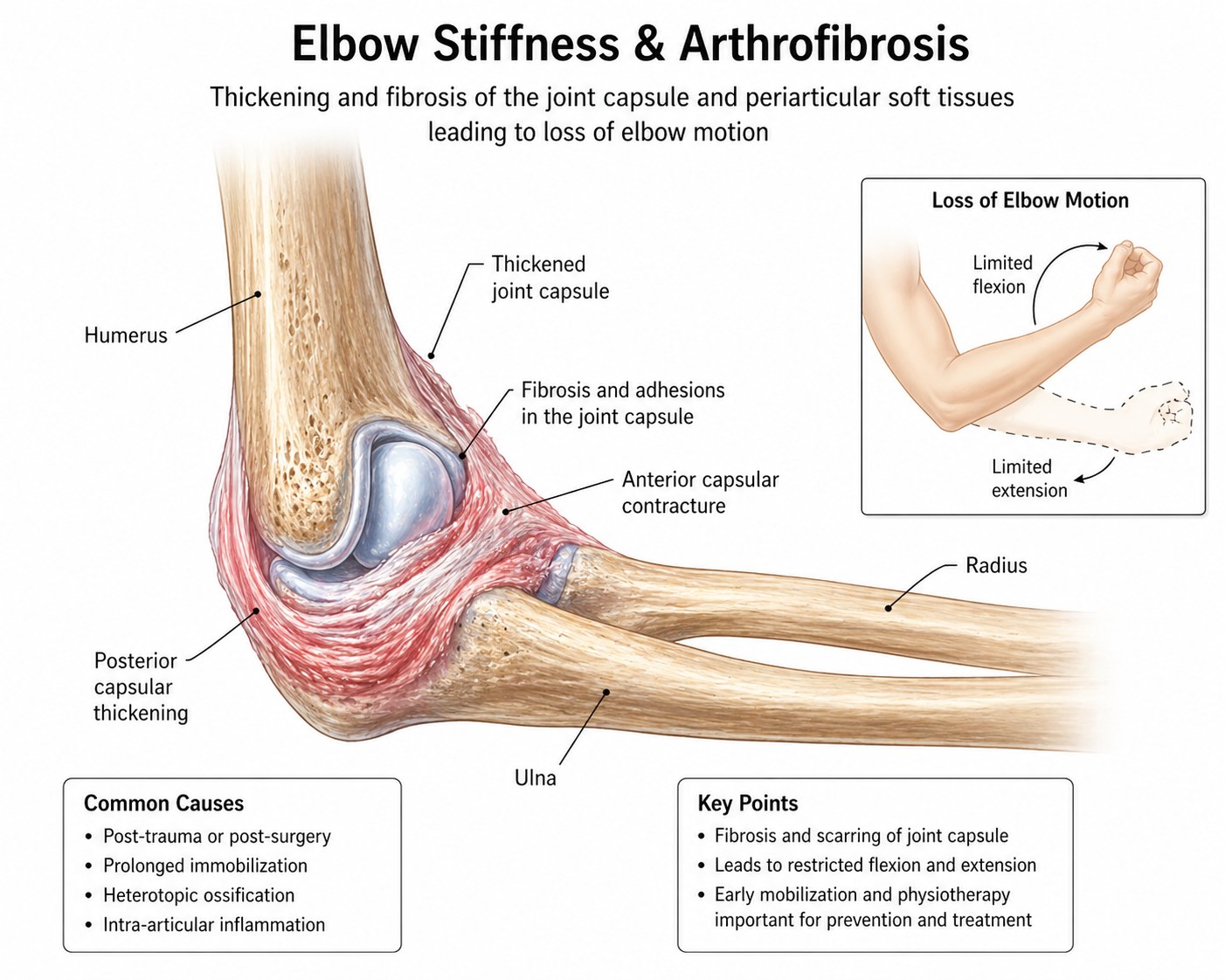
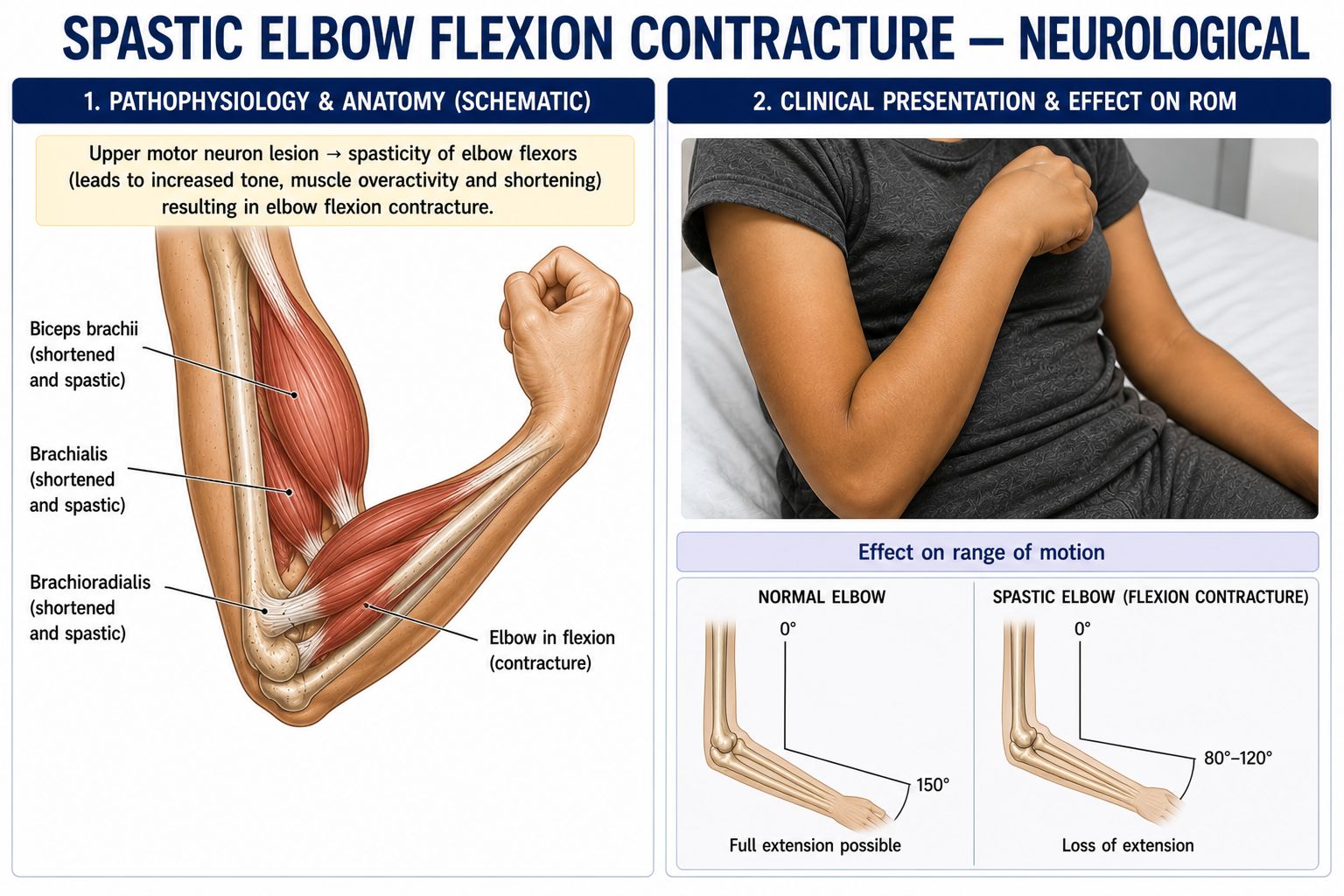
Spastic elbow flexion contracture in neurological patients — whether from stroke, cerebral palsy, traumatic brain injury, or myelopathy — is a common and disabling condition. The spastic upper motor neuron lesion causes persistent, unmodulated activation of the elbow flexor muscles (biceps, brachialis, brachioradialis), resulting in a posture of sustained elbow flexion and forearm pronation that progressively leads to fixed capsular and musculotendinous contracture.
The management is fundamentally different from post-traumatic contracture because the underlying neurological cause of the spasticity must be addressed alongside the mechanical contracture. Botulinum toxin injection — paralysing the overactive flexor muscles temporarily — is the cornerstone of non-surgical management, allowing serial casting and physiotherapy to progressively increase passive extension range. Surgery is reserved for established fixed contracture that has not responded to conservative management.
Occupational therapy plays a central role throughout — assessing functional goals, prescribing appropriate splinting, adapting activities of daily living, and maximising the functional use of the affected limb. The surgical goal is to achieve a functional range of elbow extension that improves hygiene (axilla access), dressing, and — where neurological recovery permits — active use of the arm.
Quick Facts | Details |
Also Known As | Neurogenic Elbow Flexion Contracture, Spastic Elbow, Post-Stroke Elbow Spasticity, Cerebral Palsy Elbow |
Affected Area | Elbow joint — fixed flexion deformity driven by spastic biceps, brachialis, and flexor-pronator muscles; associated with pronation contracture of the forearm |
Who It Affects | Adults with stroke (hemiplegia), traumatic brain injury, or cervical myelopathy; children and adults with cerebral palsy (spastic hemiplegia or diplegia); spinal cord injury patients; any condition causing upper motor neuron spasticity affecting the elbow |
Prevalence | Upper limb spasticity affects approximately 30–40% of stroke survivors; the elbow is one of the most commonly affected joints; elbow flexion contracture significantly impairs hygiene, dressing, and functional use of the affected limb |
Treatment | Botulinum toxin A injection (Botox) to spastic biceps and brachialis for reversible reduction of tone; serial casting to gain and maintain passive extension; Surgical: anterior capsular release + musculotendinous lengthening of biceps and/or brachialis for established fixed contracture; occupational therapy essential throughout |
Causes & Risk Factors
- Upper motor neuron (UMN) syndrome — stroke, cerebral palsy, traumatic brain injury, myelopathy; the UMN lesion causes loss of descending inhibitory signals to the spinal motor neurons; the result is spastic hypertonicity of the elbow flexors
- Muscle imbalance — in hemiplegia, the elbow flexors (biceps, brachialis) are typically more spastic than the extensors (triceps); the net effect is a persistent flexion posture
- Progressive contracture — if spasticity is not managed, the sustained flexor hypertonicity causes adaptive shortening of the muscles, tendons, and finally the joint capsule; the deformity becomes fixed
- Secondary complications — if the flexed elbow cannot be extended for hygiene, skin maceration, infection, and pressure injuries can develop in the antecubital fossa
Symptoms
- Fixed elbow flexion deformity — the elbow cannot be passively extended to a straight position; the degree varies from mild (10–20° fixed flexion) to severe (>90° fixed flexion)
- Forearm pronation — usually coexists with elbow flexion contracture; the forearm is locked in pronation as well as the elbow in flexion
- Hygiene problems — inability to access the axilla; skin maceration in the antecubital fossa crease in severe contractures; infection and skin breakdown
- Pain — may be present from contracture, particularly during passive stretching or physiotherapy
- Impaired dressing — inability to put on shirts, coats, or sleeves because the elbow cannot straighten
- Functional limitation — variable depending on the neurological recovery; in patients with some arm function, contracture directly limits hand-to-mouth activities, reaching, and self-care
How is it Diagnosed?
- Clinical examination — measure the passive extension deficit (angle of fixed flexion); assess spasticity (Modified Ashworth Scale); assess passive ROM under sedation or nerve block for true capsular vs spastic component; assess for concurrent forearm pronation contracture and wrist/finger flexion contracture
- Neurological assessment — function of the affected limb; degree of voluntary motor control; communication and cognition status; realistic functional goals
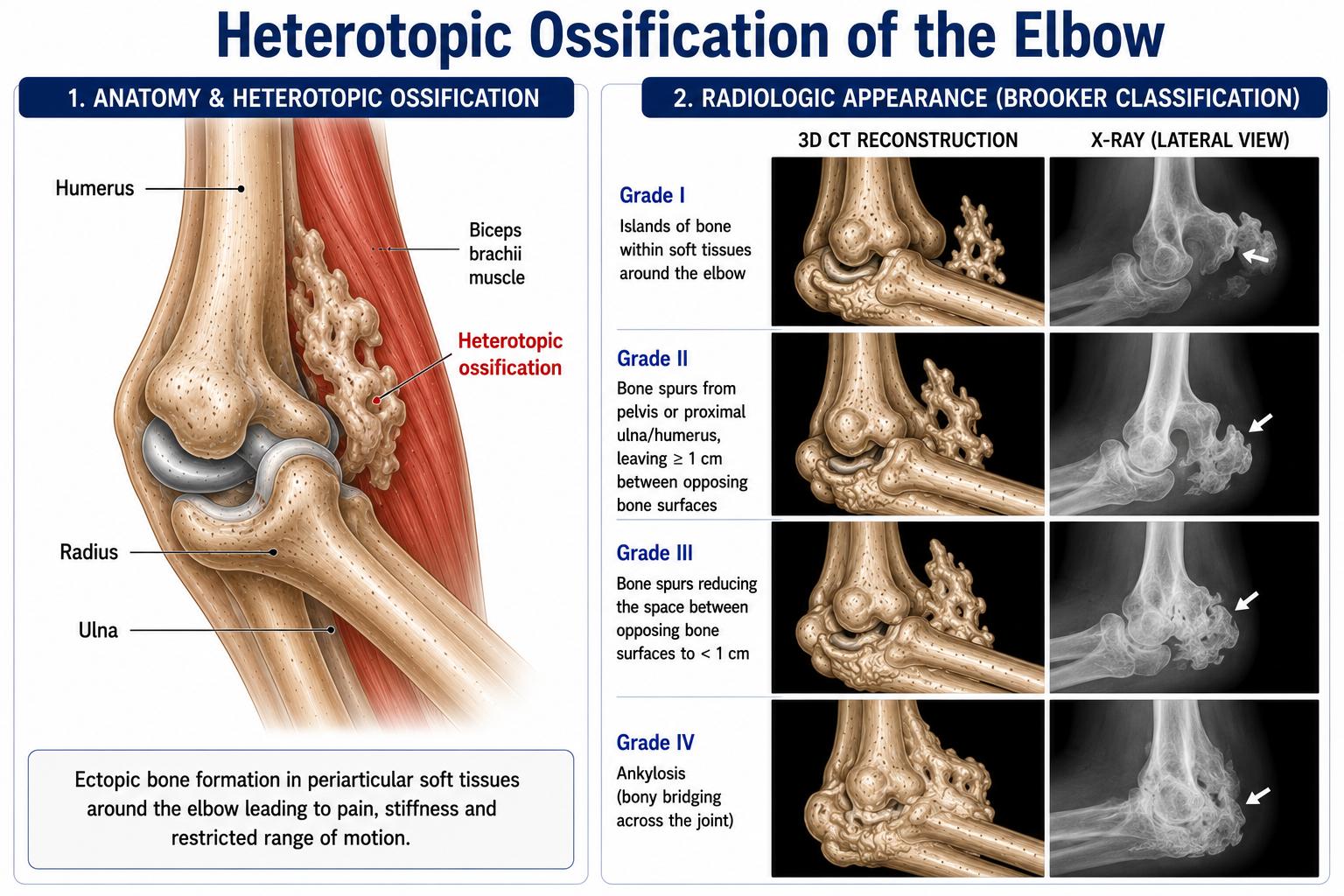
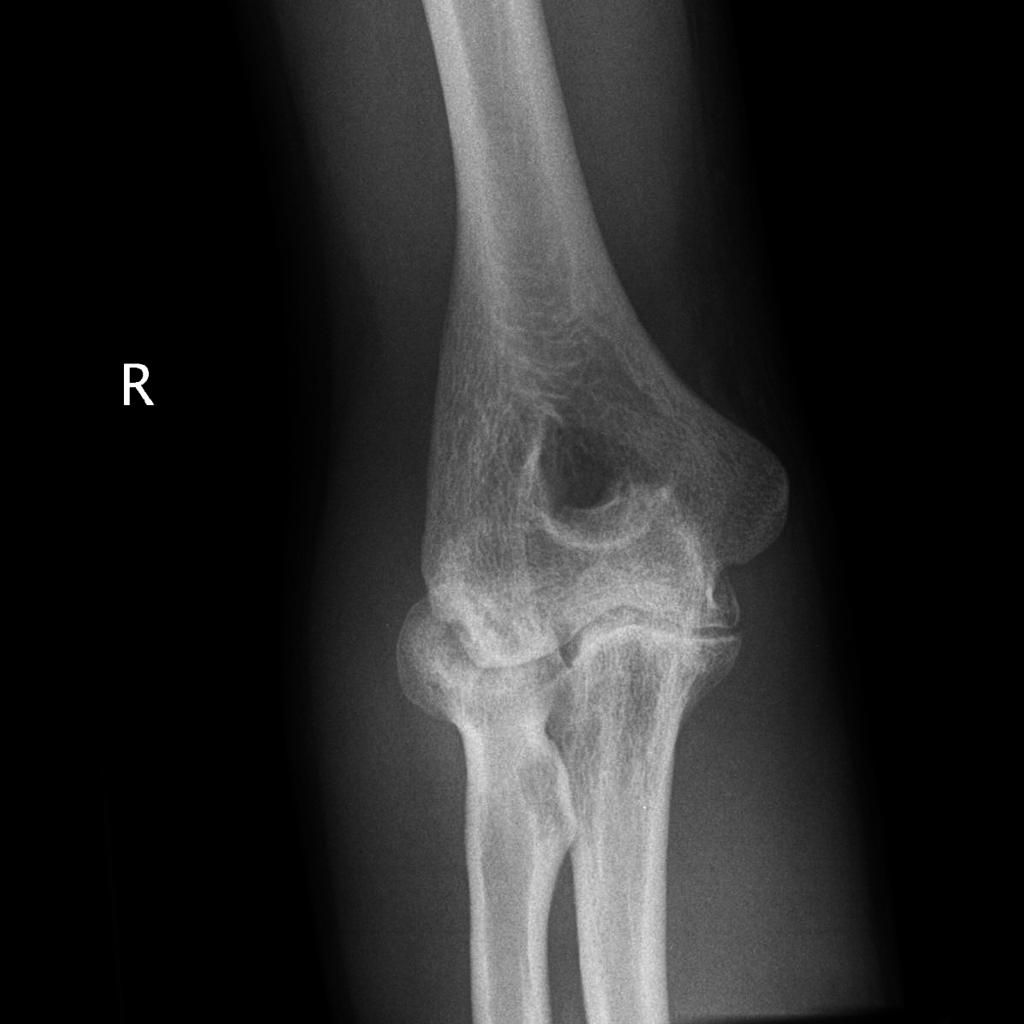
- Plain X-rays — assess joint architecture; heterotopic ossification (may coexist)
- MRI — assess for concurrent heterotopic ossification if plain X-ray is abnormal

Treatment Options
Treatment Type | Details |
Botulinum Toxin A Injection (Botox) | Injection into the spastic biceps, brachialis, and brachioradialis; reduces flexor tone for 3–4 months; allows more effective physiotherapy and casting; repeated every 3–4 months; combined with serial casting for best outcomes; best evidence for mild-moderate spastic contracture |
Serial Casting | Circular casts applied progressively at maximum passive extension; changed every 1–2 weeks; achieves gradual capsular and muscular lengthening; most effective when combined with botulinum toxin; requires patient cooperation |
Physiotherapy + Splinting | Active-assisted stretching; prolonged static splinting in extension; dynamic splinting; electrical stimulation for antagonist triceps activation; occupational therapy for functional re-training |
Surgical — Musculotendinous Lengthening | For established fixed contracture >30–40° not responding to conservative treatment; anterior approach; lengthen biceps tendon (Z-lengthening) and brachialis aponeurosis; concurrent forearm pronation release if needed; preserve neurovascular structures |
Surgical — Anterior Capsular Release | For capsular component of contracture (confirmed by no improvement under anaesthesia with musculotendinous release alone); anterior capsulotomy or capsulectomy; combined with musculotendinous lengthening in most cases |
Post-operative Immobilisation and Physiotherapy | Post-op cast in maximum extension for 4–6 weeks; aggressive physiotherapy and splinting after cast removal; botulinum toxin post-operatively to prevent recurrence of spastic tone |
Recovery & Rehabilitation
- After botulinum toxin + serial casting: gains achieved over 8–12 weeks; typically 20–40° of improved extension; lasts 3–6 months before repeated injections needed
- After surgical release: cast 4–6 weeks; aggressive physiotherapy and night splinting to maintain gains; botulinum toxin post-op to prevent spastic recurrence
- Realistic expectations: surgery achieves passive extension improvement; active extension recovery depends on underlying neurological recovery (may not improve with surgery)
- Key principle: treat the spasticity (botulinum toxin) and the contracture (casting + surgery) as separate but concurrent problems
Why choose Dr Senthilvelan?
Spastic elbow flexion contracture requires a coordinated multidisciplinary approach — integrating the neurological management (spasticity treatment), the orthopaedic surgical correction (musculotendinous lengthening and capsular release), and the ongoing rehabilitation (occupational therapy and physiotherapy). Dr Senthilvelan works within the MIOT International neurorehabilitation team to provide comprehensive upper limb management for patients with neurological conditions.
Frequently Asked Questions
1. My mother had a stroke and her elbow is now bent — can this be fixed?
Yes — elbow flexion contracture after stroke can be significantly improved with appropriate management. The initial approach is botulinum toxin injection (Botox) to the spastic elbow flexor muscles, which temporarily reduces the muscle tone and allows progressive casting and physiotherapy to gain passive extension range. This non-surgical approach is effective for mild-moderate contractures. For severe, fixed contractures that have not responded to conservative treatment, surgical lengthening of the biceps and brachialis tendons can achieve significant passive extension improvement.
2. What is botulinum toxin treatment and how long does it last?
Botulinum toxin A (Botox) is injected directly into the spastic biceps and brachialis muscles under ultrasound guidance. It temporarily paralyses the overactive muscle fibres by blocking neuromuscular transmission. The effect begins within 1–2 weeks and lasts for 3–4 months. During this window, physiotherapy, serial casting, and splinting are much more effective because the muscle resistance is reduced. The injection is repeated every 3–4 months as needed. It is not permanent — spasticity returns as the nerve endings regenerate — but it can be used long-term as part of an ongoing management plan.
3. Is surgery always needed for a bent elbow after stroke?
No. Many patients respond well to botulinum toxin injections combined with serial casting and physiotherapy, avoiding the need for surgery. Surgery is generally considered when: the contracture is fixed (cannot be passively corrected even under general anaesthesia); the fixed deformity is causing hygiene problems, skin breakdown, or pain; or the contracture is preventing the patient from achieving realistic functional goals. Surgery is most beneficial in motivated patients with realistic goals and with adequate neurological recovery to benefit from improved passive extension.
4. What are realistic expectations from surgery?
Surgery for spastic elbow contracture improves passive extension range — the ability of the arm to be passively straightened for hygiene and dressing. Active extension recovery (the ability to actively straighten the elbow) depends on the underlying neurological recovery from the stroke or brain injury, which surgery does not directly affect. Realistic goals are: better axilla hygiene; easier dressing; reduced skin complications; and improved cosmesis. In patients with partial motor recovery, improved passive extension can also facilitate more effective voluntary arm use.
5. My child with cerebral palsy has a bent elbow — is treatment different from stroke?
The principles are similar but with important differences. In cerebral palsy, the child is still growing — which creates both more flexibility in tissue lengthening and the risk that contracture recurs as growth continues. Treatment in children typically involves: splinting from an early age to prevent contracture progression; botulinum toxin injections starting in the pre-school years; serial casting; and surgical lengthening timed carefully relative to the child’s growth, functional goals, and readiness for rehabilitation. The child’s cognitive ability and cooperation are also important factors in planning treatment timing and type.