Overview
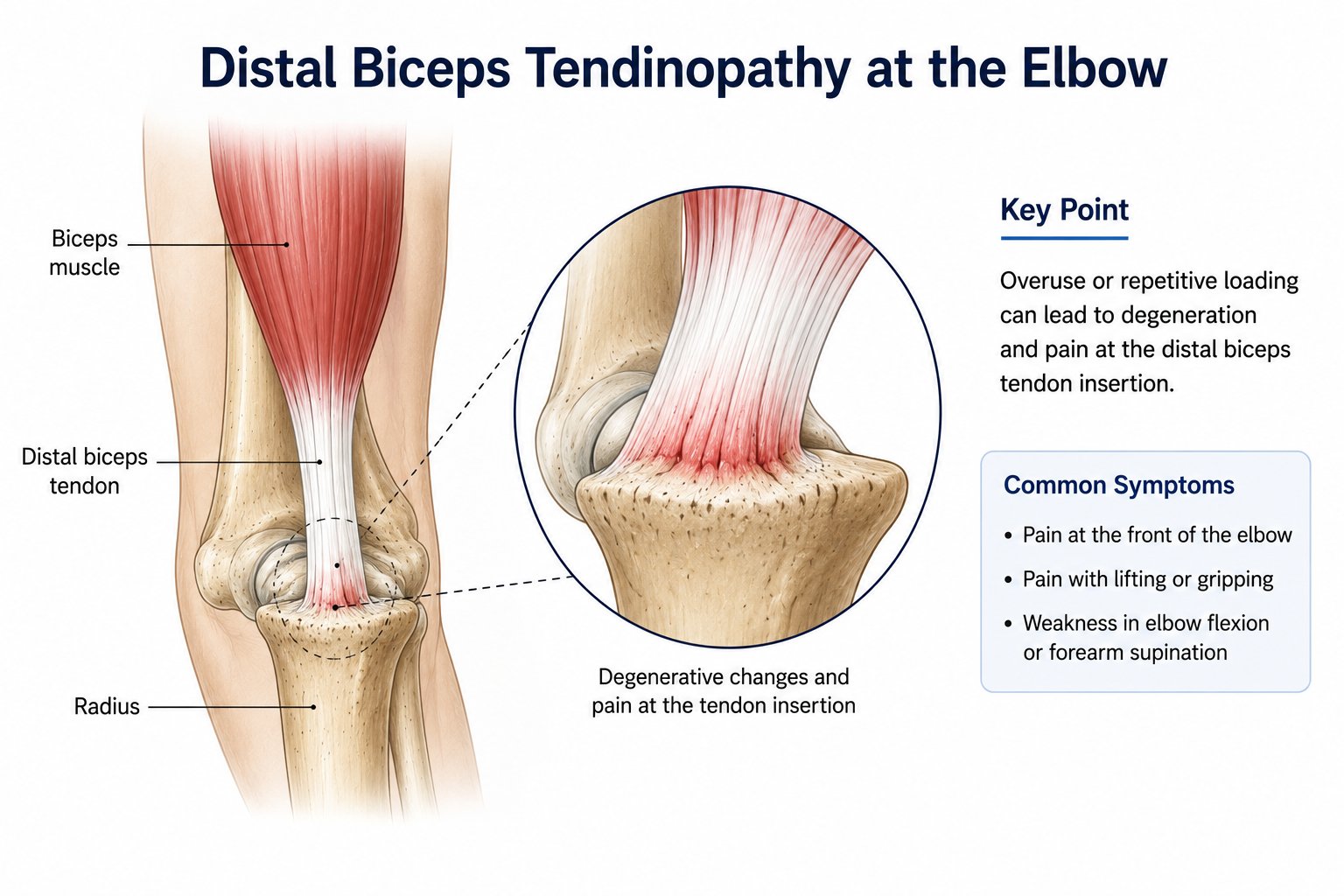
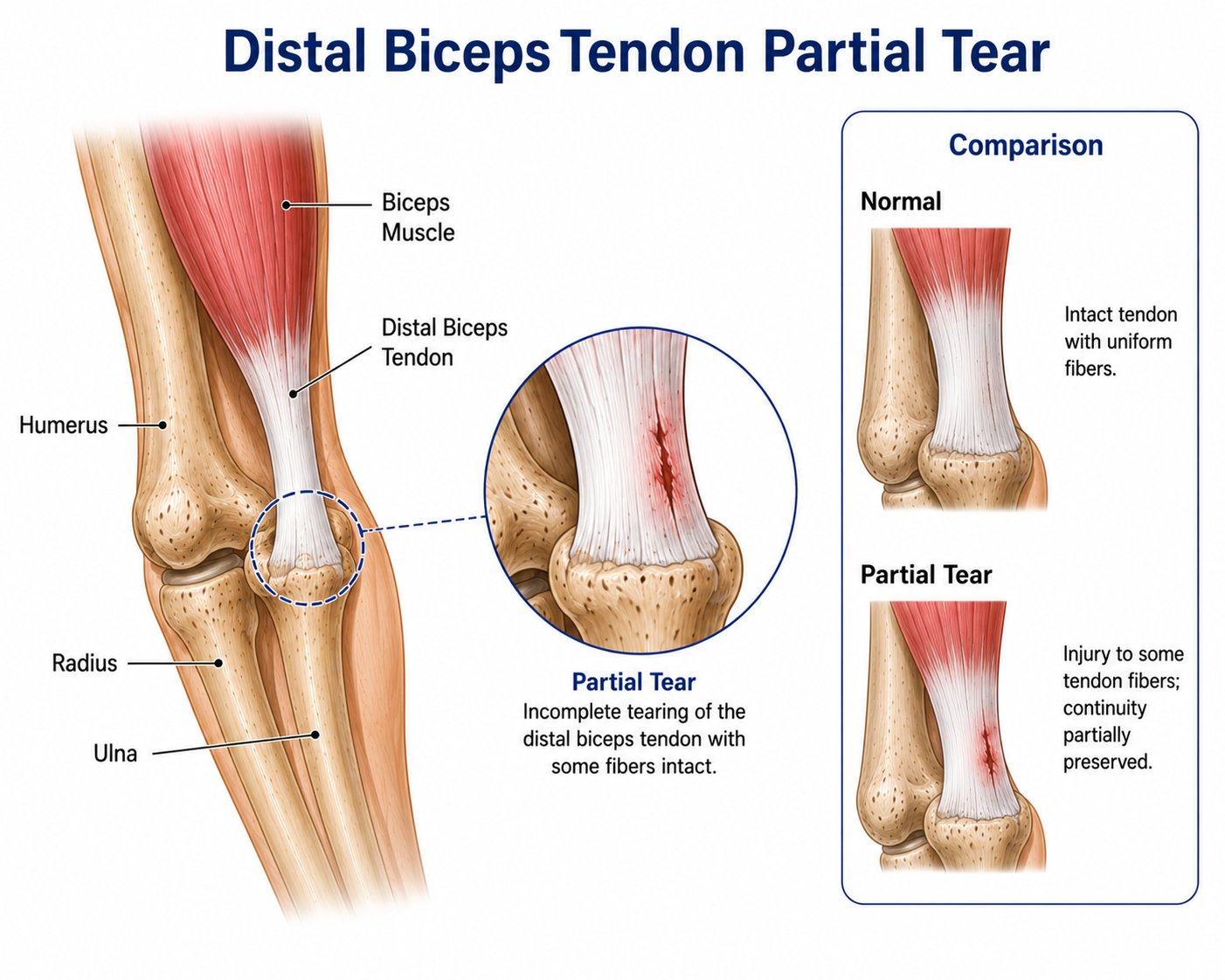
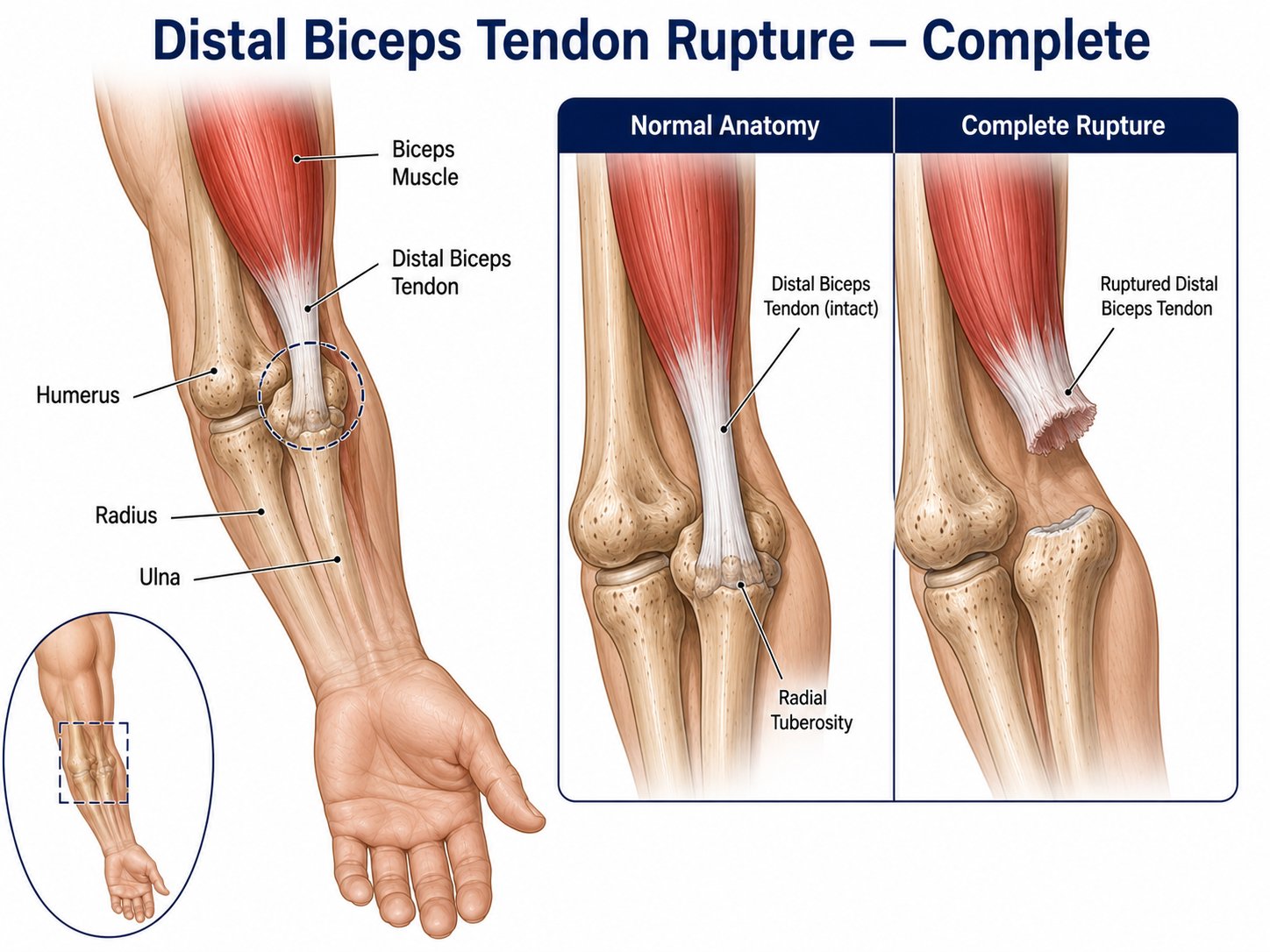
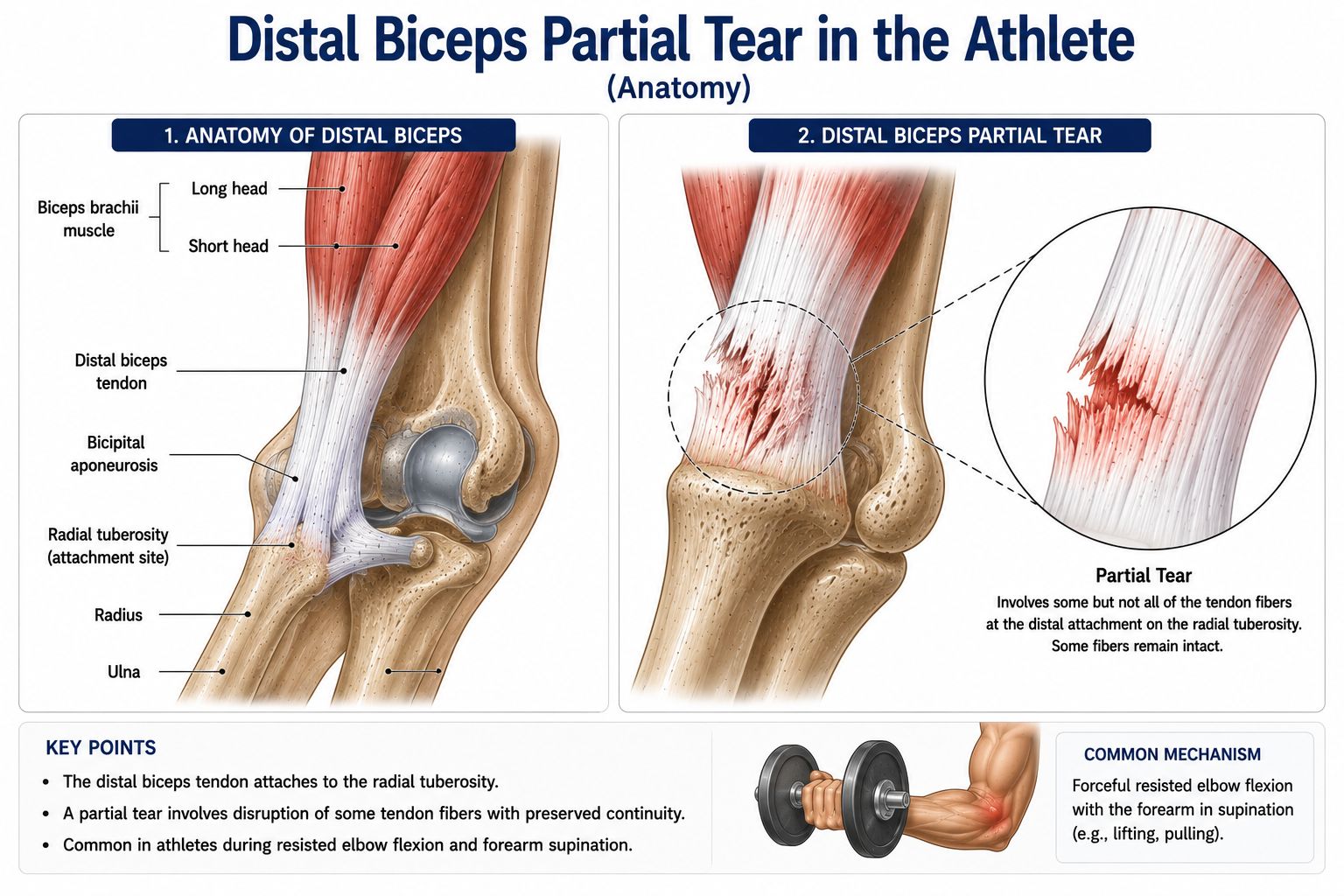
Distal biceps partial tears in athletes occur when the high-force eccentric loading demanded by athletic activity partially disrupts the biceps tendon fibres at or near the radial tuberosity insertion. Unlike in the general population where partial tears typically develop insidiously from chronic overuse, in athletes the injury often has a more acute-on-chronic component — a specific loading event (a missed catch, a maximal curl, a tackle) superimposed on chronic tendon degeneration.
The athletic context introduces specific management challenges: the athlete requires a return to high-force supination and elbow flexion loading that places unique demands on the healing tendon; the tolerance for prolonged rest is often limited; and the risk of progression to complete rupture — which would require a much longer recovery — creates urgency in management decisions.
For competitive athletes with partial distal biceps tears, the FABS-sequence MRI is the essential investigation — it precisely quantifies the tear thickness (the most important factor in determining treatment), assesses the bicipitoradial space for impingement, and excludes a concurrent complete rupture. Tears involving less than 50% of the tendon can be managed conservatively with PRP; tears involving more than 50% are at significant risk of completion and require surgical consideration.
Quick Facts | Details |
Also Known As | Partial Distal Biceps Tear — Athlete, Biceps Insertion Partial Avulsion, Athletic Biceps Tendon Injury |
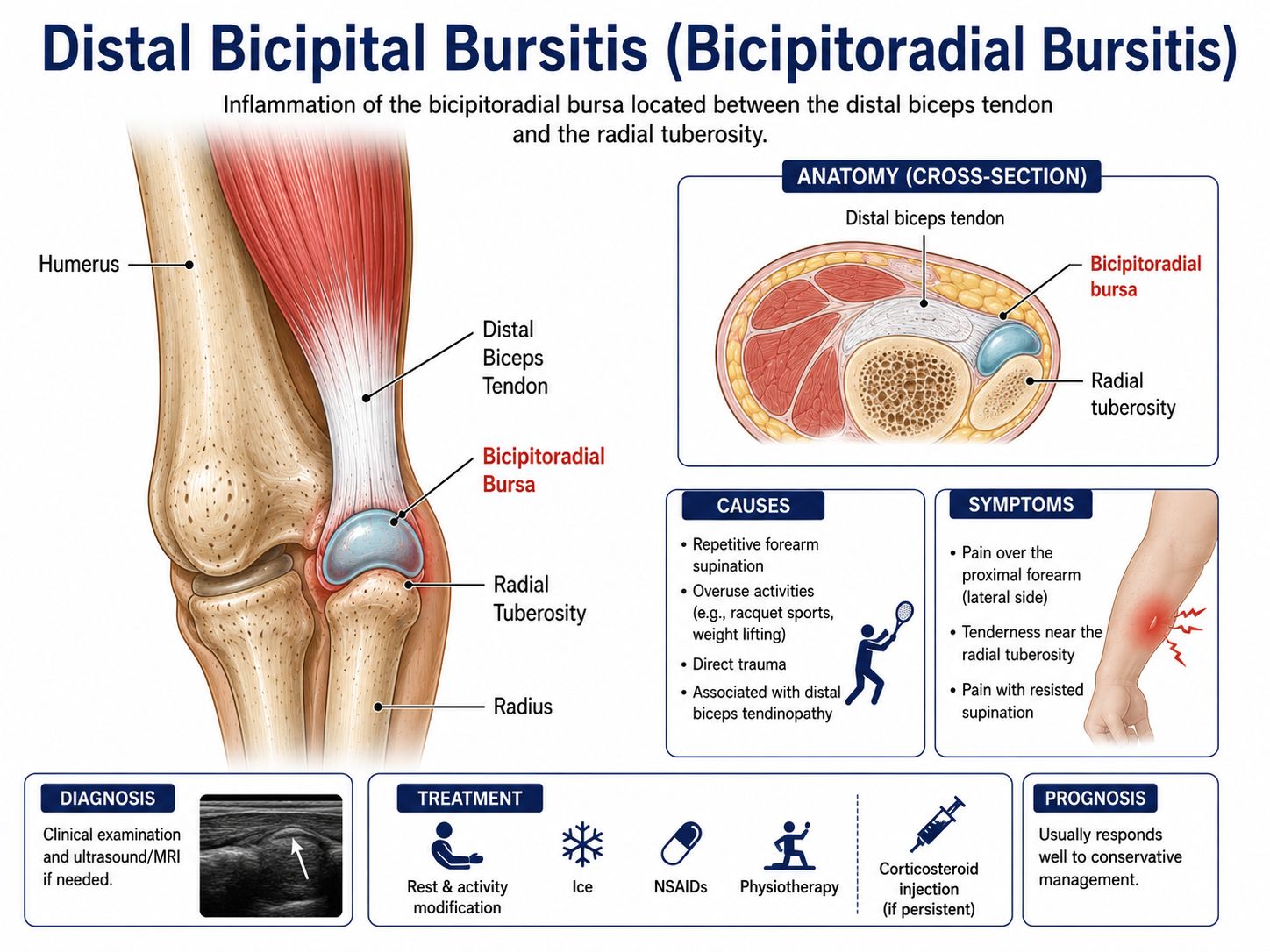
Affected Area | Distal biceps tendon at the radial tuberosity insertion and the near-insertion zone; bicipitoradial space |
Who It Affects | Active athletes — weightlifters, climbers, wrestlers, gymnasts, rugby players, cricket bowlers; predominantly men aged 30–55 years; the dominant arm; injury characteristically occurs during a high-force eccentric biceps contraction |
Prevalence | Partial distal biceps tears are thought to be underdiagnosed in the athletic population; MRI studies of athletes with anterior elbow pain suggest partial tears in 30–40% of symptomatic cases; an important diagnosis that precedes many complete ruptures if not recognised and managed |
Treatment | <50% tear: MRI assessment + relative rest 3–6 months + PRP injection for persistent symptoms; >50% tear: surgical repair/débridement; serial MRI monitoring in competitive athletes; return to sport 4–6 months |
Causes & Risk Factors
- Eccentric overload — the primary mechanism in athletes; a sudden unexpected load applied to the biceps during a supination-flexion task; catching a heavy object, a wrestling grip break, a tackle impact
- Chronic overuse with acute-on-chronic rupture — progressive degeneration from repetitive supination loading (weightlifting, climbing) weakens the tendon, followed by a provocative event
- Rock climbing — the crimp grip and dynamic loading during dyno moves subject the biceps to extreme supination and flexion forces
- Weightlifting — heavy barbell curls and supinated pull-ups; particularly with maximum-effort attempts
- Wrestling and combat sports — grip-fighting and arm control with explosive supination
- Cricket fast bowling — the biceps is under significant eccentric load during the delivery stride and follow-through
Symptoms
- Anterior elbow pain — in the antecubital fossa, along the distal biceps tendon; acute onset in some cases with a specific event; chronic aching in overuse-dominant presentations
- Pain with resisted supination — the most consistent provocative test in athletes
- Pain with maximum-effort lifting — the athlete cannot perform at pre-injury level without anterior elbow pain
- Mild supination weakness — 10–30% reduction compared to the contralateral arm; much less than a complete rupture
- Tendon tenderness — along the distal biceps in the antecubital fossa; sometimes a palpable thickening
- Hook test positive for continuity — a cord is palpable on hook testing (distinguishes from complete rupture)
- Performance limitation — reduced power output in climbing, weightlifting, or throwing
How is it Diagnosed?
- Clinical examination — hook test (confirms tendon continuity); resisted supination provocation; palpation along the distal biceps; compare supination strength bilaterally
- MRI with FABS sequence — gold standard; T2 signal in the tendon; percentage thickness of tear; bicipitoradial bursal fluid; concurrent bicipitoradial space assessment; this investigation determines treatment
- Ultrasound — experienced musculoskeletal sonographer; partial tearing; Doppler neovascularity; bicipitoradial bursitis; dynamic assessment during forearm rotation
Treatment Options
Treatment Type | Details |
Rest & Load Management | Reduce supination-dominant training; avoid heavy barbell curls and supinated loading; eccentric biceps exercises within pain-free range after initial rest period 2–4 weeks |
PRP Injection (First-Line for <50% Tear) | Ultrasound-guided PRP injection at the tear zone; 6 weeks of restricted supination loading after injection; 50–70% of athletes with <50% tears return to full competition without surgery; preferred over corticosteroid (which risks tendon weakening near the insertion) |
Serial MRI Monitoring | MRI at 6 and 12 weeks to assess healing; progression of tear (increasing thickness) is an indication for earlier surgical intervention; stability of tear size is reassuring |
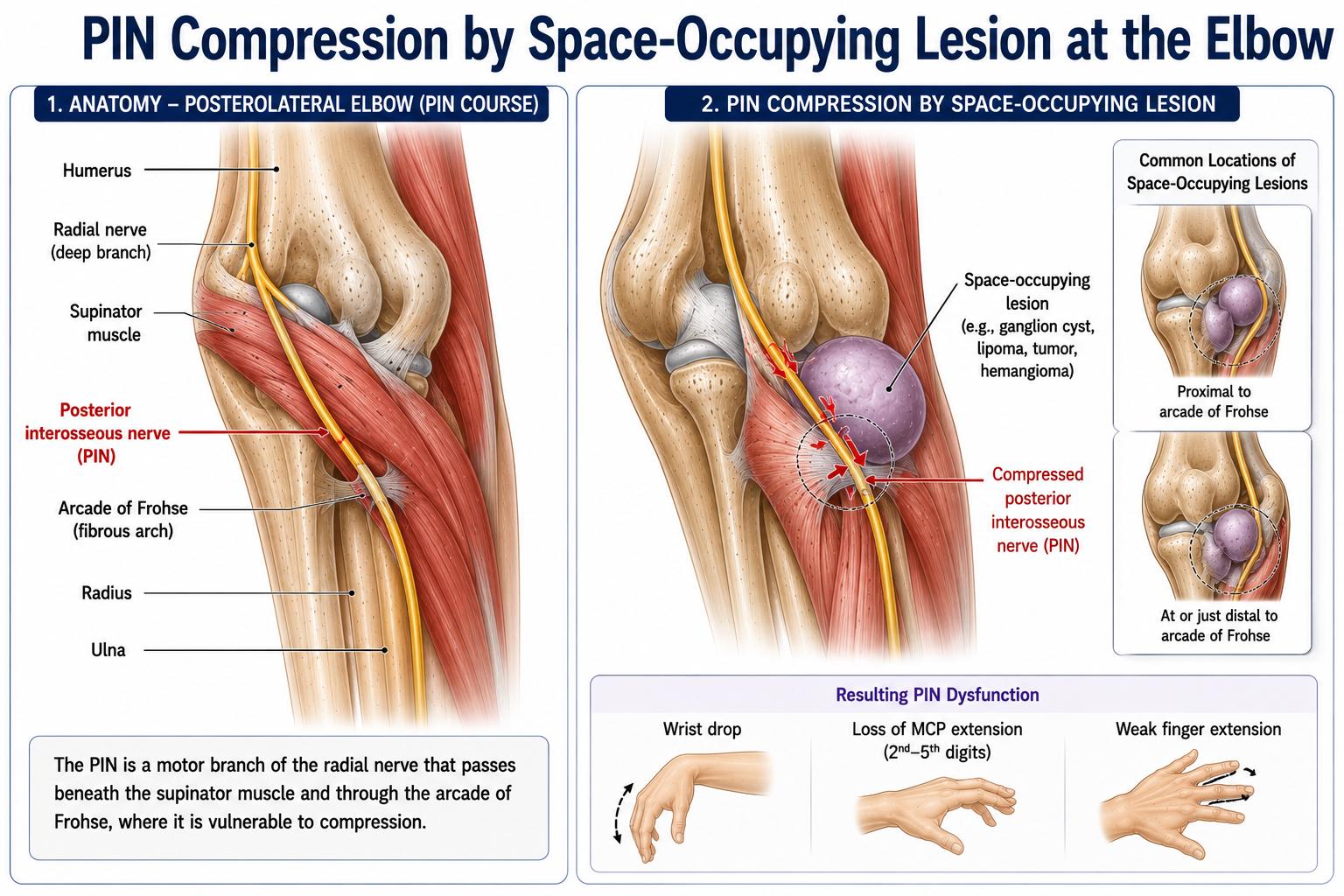
Surgical Repair / Débridement (>50% Tear or Failed Conservative) | Single anterior incision approach; débridement of degenerate tendon tissue; suture anchor or endobutton reinsertion onto radial tuberosity; PIN identified and protected throughout; augmentation if significant tissue loss; for competitive athletes who need to return to full supination loading rapidly |
Activity-Specific Return-to-Sport Programme | Sport-specific progressive loading: for climbers — progression from juggy holds to crimps over 3–4 months; for weightlifters — progression from neutral-grip to fully supinated heavy loading over 3–4 months; for wrestlers — isometric to progressive supination resistance over 12 weeks post-PRP |
Recovery & Rehabilitation
- PRP: 6 weeks rest from supination loading; graduated return to sport-specific activities 8–12 weeks; full training volume and intensity at 4–5 months
- After surgical repair: posterior splint 2 weeks; active ROM from week 2; strengthening from week 6; return to full competitive loading 4–6 months
- Expected outcomes: 85–90% return to previous sport level with appropriate management
- Prevention: maintain adequate eccentric biceps conditioning; avoid sudden increases in supination loading volume; monitor for prodromal symptoms (anterior elbow aching with maximum-effort supination)
Why choose Dr Senthilvelan?
Distal biceps partial tears in athletes require accurate FABS-sequence MRI grading and sport-specific management — PRP with a structured return-to-sport programme for smaller tears, and timely surgical repair for larger ones that pose a risk of completion. Dr Senthilvelan integrates the clinical assessment, imaging, and sport-specific rehabilitation pathway into a clear, individualised management plan.
Frequently Asked Questions
1. I am a weightlifter and had an acute anterior elbow pain during a heavy curl — do I need to stop training completely?
Not necessarily. The first step is accurate diagnosis — a clinical assessment including the hook test to confirm tendon continuity, and an urgent MRI with the FABS sequence to determine whether you have a partial tear and what percentage of the tendon is involved. If the tear involves less than 50% of the tendon, modified training (avoiding heavy supinated loading for 4–6 weeks) combined with PRP injection gives 50–70% of athletes a full return to previous training levels. Complete rest is rarely required — just targeted load management while healing occurs.
2. What loading can I do while a partial biceps tear is healing?
During the rest period (4–6 weeks after PRP): neutral-grip activities (hammer curls, neutral pull-ups) are much better tolerated than supinated loading and help maintain biceps conditioning without stressing the tear. Rope pull-ups, cable rows, and lat pulldowns can continue. Avoid: barbell curls, supinated dumbbell curls, chin-ups, and any maximal supination effort. As healing progresses (8–12 weeks), neutral loading can be progressively increased, with supinated loading reintroduced at 12 weeks if pain-free.
3. Will a partial biceps tear always progress to a complete rupture?
No — most partial tears involving less than 50% of the tendon thickness can heal successfully with appropriate rest, PRP, and load management without progressing to complete rupture. The risk of progression is highest in: tears involving more than 50% of the tendon; athletes who continue with heavy supinated loading without modification; and older athletes with pre-existing tendon degeneration. Serial MRI monitoring at 6 and 12 weeks allows early detection of tear progression — the most important reason for re-imaging rather than simply waiting.
4. How is the FABS sequence MRI different from a normal MRI of the elbow?
Standard elbow MRI is performed with the patient lying supine with the arm at the side, palm down. In this position, the distal biceps tendon wraps around the radial tuberosity and is not visualised along its full length. The FABS sequence (Forearm Abducted, Bicep Supinated) is performed with the arm raised above the head and the forearm fully supinated — this straightens the biceps tendon and allows it to be imaged along its entire length from the musculotendinous junction to the insertion. It is far more sensitive for detecting and quantifying partial tears than standard elbow MRI positioning.
5. If I need surgery, can I choose timing to fit my competition season?
Yes — for partial tears managed conservatively with PRP, if the decision is made to proceed to surgery (because conservative treatment has failed or the tear has progressed), the timing can usually be planned to fit around competition demands. Surgery is elective in these cases — it is not an emergency. Planning surgery at the end of the competitive season, with recovery during the off-season, allows a full return to competition 4–6 months later at the start of the next season. Dr Senthilvelan can discuss the optimal timing relative to your specific sport and competition calendar.