Overview
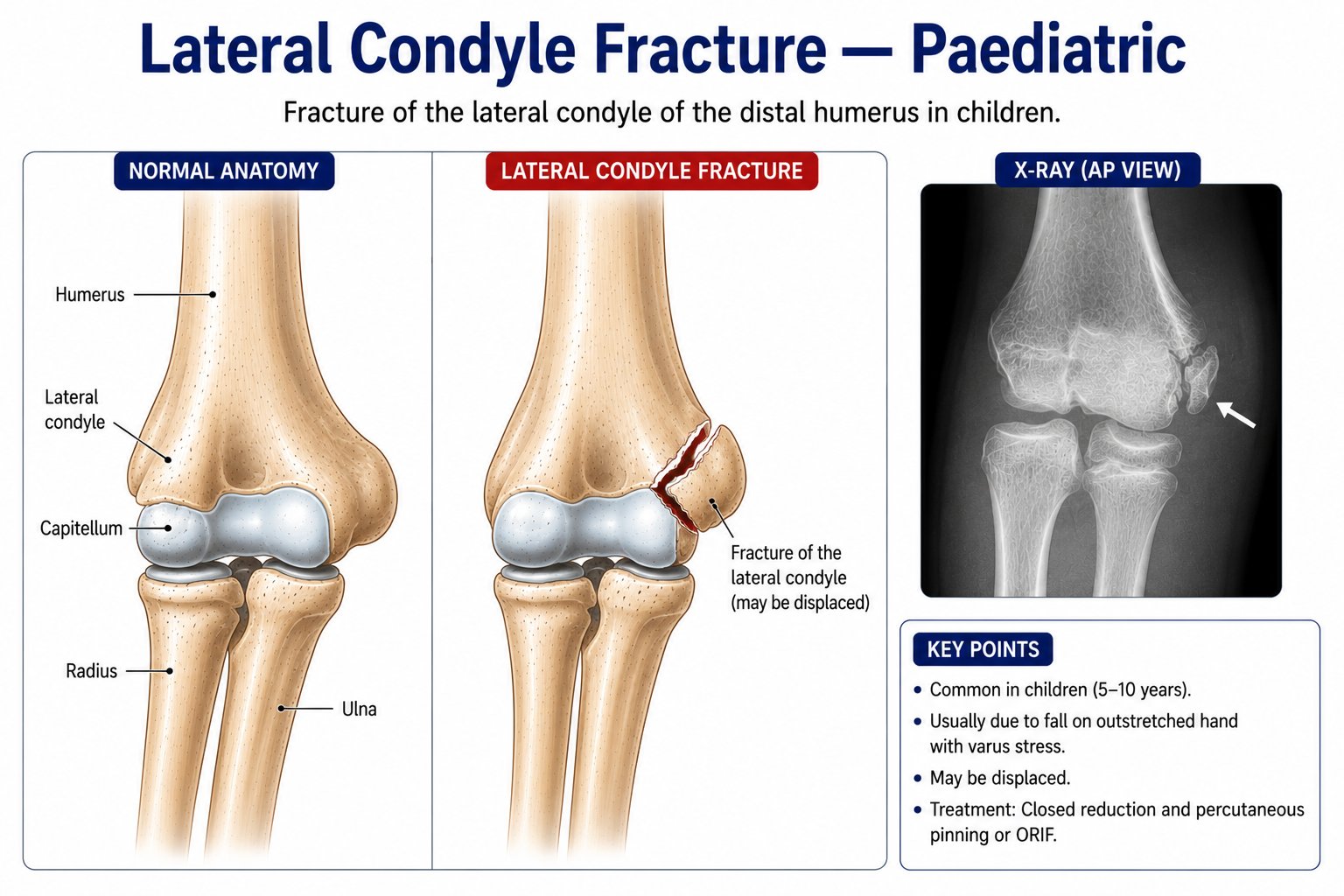
Lateral condyle fractures in children are fractures of the lateral condyle of the distal humerus that typically occur between the ages of 5 and 10 years — the age range when the lateral condyle ossification centre is present but the lateral trochlear ridge is still largely cartilaginous. Because a large portion of the fracture fragment is unossified cartilage, the fracture extent is significantly larger than what is visible on plain X-ray — making these injuries more complex and potentially more unstable than they initially appear.
The fracture is classified by the Milch system (Type I: fracture line lateral to the trochlear groove — does not extend into the joint — technically stable; Type II: fracture through the trochlear groove into the joint — unstable, the elbow can dislocate). The more commonly used Jakob classification grades displacement: Stage I (<2mm displacement, cartilage hinge intact), Stage II (≥2mm displacement, cartilage hinge intact but fracture beginning to rotate), Stage III (completely displaced, rotated fragment).
The most important clinical point about lateral condyle fractures in children is that they may initially appear minimally displaced on X-ray but can displace significantly over the first 7–10 days as the child uses their arm. Weekly X-ray follow-up for the first 2–3 weeks is essential in all cases — including those treated non-operatively. Missed or malunited lateral condyle fractures cause fishtail deformity of the trochlea, cubitus valgus, tardy ulnar nerve palsy, and lateral overgrowth.
Quick Facts | Details |
Also Known As | Lateral Condyle Fracture Child, Paediatric Elbow Fracture Lateral, Milch Fracture |
Affected Area | Lateral condyle of the distal humerus in children — includes the capitellum, lateral trochlear ridge, and lateral epicondyle apophysis; the fracture line extends through the unossified cartilage |
Who It Affects | Children aged 5–10 years predominantly; the second most common elbow fracture in children after supracondylar fractures; typically from a fall onto an outstretched hand with a varus stress |
Prevalence | Accounts for approximately 12–17% of paediatric elbow fractures; the most common cause of malunion and late cubitus valgus deformity in children if inadequately treated |
Treatment | Undisplaced (<2mm, Milch Type I equivalent): non-operative with cast immobilisation; Displaced (>2mm): ORIF with K-wires or cannulated screws; open reduction if articular incongruity; AVN and lateral spur surveillance on X-ray |
Causes & Risk Factors
- Fall onto an outstretched hand — the most common mechanism; varus stress applied to the extended elbow avulses the lateral condyle through tension on the attached lateral ligament complex and common extensor origin
- Fall onto a flexed elbow — less common; an axial compressive force through the radial head against the capitellum can also cause a lateral condyle fracture
- Combination of pull and compression — the avulsion component from the common extensor origin and LCL (pulling the fragment laterally) combined with the compressive force from the radial head against the capitellum
Symptoms
- Lateral elbow pain — localised to the lateral condyle area in a child aged 5–10 years after a fall
- Swelling — lateral elbow swelling; often less dramatic than supracondylar fracture swelling
- Tenderness over the lateral condyle — directly over the lateral elbow; may be more focal than supracondylar fracture tenderness which is diffuse
- Restricted elbow movement — the child holds the arm still; refuses to move the elbow
- Subtle deformity — in displaced fractures, a step-off may be palpable laterally
- Normal neurovascular status — unlike supracondylar fractures, neurovascular compromise is rare in lateral condyle fractures
How is it Diagnosed?
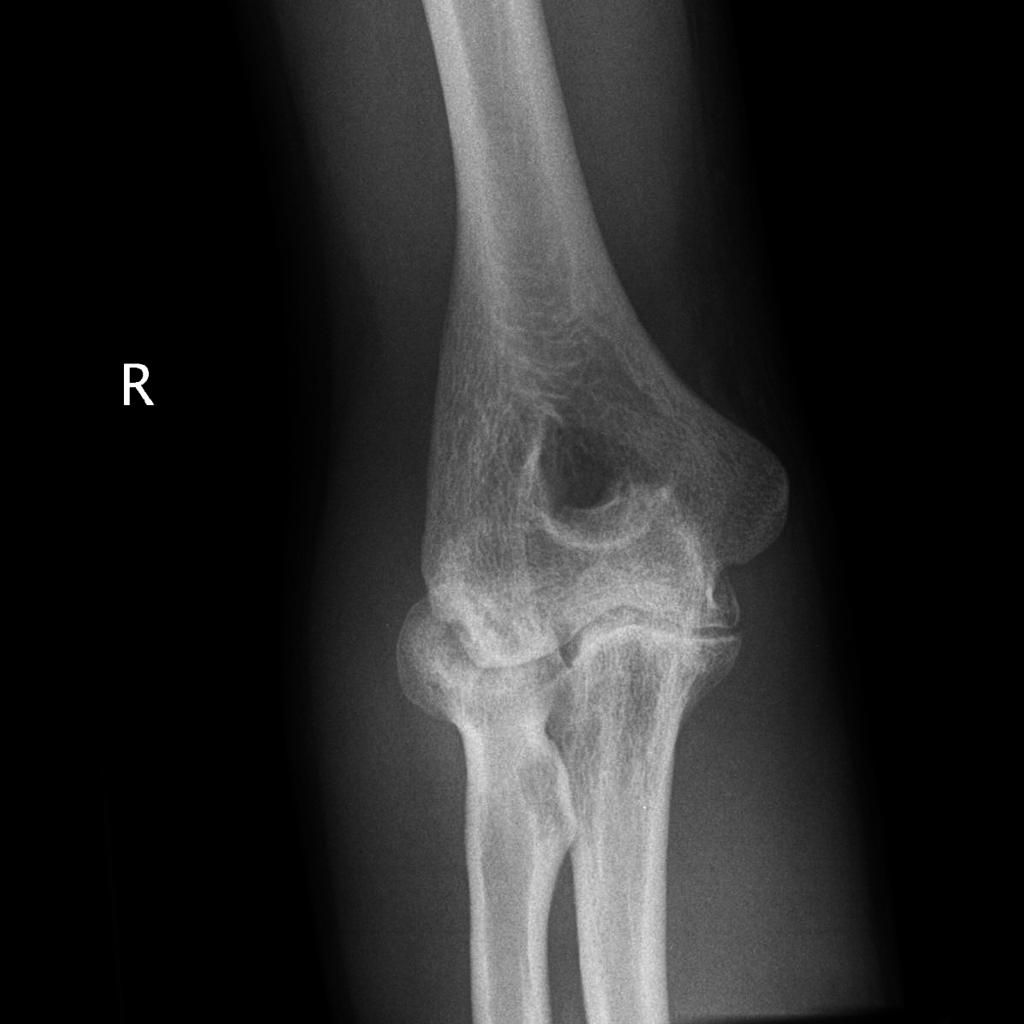
- Plain X-rays (AP + lateral + oblique) — the oblique (internal rotation) view best demonstrates the lateral condyle fracture; assess displacement (Jakob staging); fat pad sign
- CRITICAL NOTE: The full fracture extent is larger than visible on X-ray — the cartilaginous portion is invisible; do not underestimate displacement
- MRI or arthrogram — arthrogram (contrast injection into elbow joint) is most useful in young children (under 3 years with minimal ossification) to define true fracture extent; MRI defines the cartilaginous component; used selectively
- CT scan — rarely used in children due to radiation; reserved for complex or atypical fracture patterns
- Weekly X-ray follow-up (first 2–3 weeks) — ESSENTIAL for all initially non-operative cases; displacement can occur in fractures that initially appear stable

Treatment Options
Treatment Type | Details |
Non-Operative (Jakob Stage I, <2mm) | Above-elbow cast in 90° flexion for 3–4 weeks; weekly X-ray for first 3 weeks to confirm no displacement; if displacement occurs: convert to surgery immediately |
ORIF with K-Wires (Jakob Stage II-III) | Closed or open reduction; 2 smooth K-wires (1.6–2.0mm) inserted laterally through the skin; confirm anatomical reduction fluoroscopically including articular surface; K-wires left percutaneous for removal at 3–4 weeks; above-elbow cast for 4 weeks |
Open Reduction | For Stage III (completely rotated fragment) or when closed reduction fails; lateral approach; open the fracture plane; reduce fragment anatomically (articular surface must be perfectly reduced); K-wire fixation; send fragment for histology only if tumour suspected — routine histology not needed |
Cannulated Screw Fixation (Older Children) | In children over 8 years with larger ossified fragments: cannulated compression screw provides stronger fixation than K-wires; buried under skin (avoids infection risk of percutaneous K-wires) |
Malunion Treatment | Late presentation (>3 weeks) or established malunion: open reduction may still be possible at 3–6 weeks; after 6+ weeks: correction more difficult; cubitus valgus osteotomy for symptomatic deformity and tardy ulnar nerve palsy |
Recovery & Rehabilitation
- Non-operative: cast 3–4 weeks; X-ray at removal; physiotherapy for ROM recovery 4–6 weeks
- After K-wire fixation: above-elbow cast 3–4 weeks; K-wire removal at 3–4 weeks in outpatient department; physiotherapy to restore ROM 4–6 weeks
- Full elbow movement: typically regained within 6–8 weeks post-treatment
- AVN surveillance: X-ray at 3, 6, and 12 months; AVN appears as capitellum fragmentation on X-ray
- Lateral spur and fishtail deformity: monitored on serial X-rays over several years; most are asymptomatic
- Cubitus valgus: followed until skeletal maturity if minor; corrective osteotomy if symptomatic or causing tardy ulnar nerve palsy
Why choose Dr Senthilvelan?
Paediatric lateral condyle fractures require careful clinical and radiographic assessment, strict follow-up protocols (weekly X-rays for initial non-operative cases), and precise surgical technique when fixation is needed — particularly ensuring perfect articular surface reduction since even small articular step-offs in a growing child can cause long-term deformity. Dr Senthilvelan has specific training in paediatric elbow fractures and understands the unique challenges of treating injuries involving unossified cartilage.
Frequently Asked Questions
1. My child has a small lateral condyle fracture on X-ray — do they really need surgery?
Not necessarily — but the key is very careful monitoring. Fractures with less than 2mm displacement (Jakob Stage I) can be treated in an above-elbow cast, but weekly X-rays for the first 2–3 weeks are essential because these fractures can displace. If displacement is detected early, surgery (K-wire fixation) can still give excellent results. The danger is in missing displacement at the weekly follow-up — delayed treatment of a displaced lateral condyle fracture significantly increases the risk of malunion, deformity, and long-term complications.
2. Why is the lateral condyle fracture in children more serious than it looks on X-ray?
Because a large portion of the fracture fragment in young children is unossified cartilage — completely invisible on X-ray. The apparent small bony chip on X-ray may in reality be a large osteochondral fragment involving a significant part of the articular surface and the lateral column of the distal humerus. This is why fractures that appear minor on X-ray can still be unstable and require surgical fixation, and why arthrogram or MRI is sometimes used in young children to define the true fracture extent.
3. What is the fishtail deformity and cubitus valgus I was warned about?
Lateral condyle malunion can cause two long-term deformities: fishtail deformity (a notch in the trochlea where the fracture line healed with a step, visible on X-ray as a V-shaped indentation of the trochlear surface) and cubitus valgus (an increased carrying angle, where the arm angles outward). Cubitus valgus causes progressive stretch on the ulnar nerve — the so-called ‘tardy ulnar nerve palsy’, where tingling and weakness in the ring and little fingers develop many years after the original fracture. These complications are avoidable with accurate initial treatment.
4. Will my child have a normal elbow after this fracture?
With prompt, correct treatment (accurate reduction and stable fixation of displaced fractures), the vast majority of children have an excellent long-term outcome with a normal-functioning elbow. The capitellum growth plate is often involved, and a small lateral spur (overgrowth) is common and usually asymptomatic. The critical determinant of outcome is the accuracy of articular surface reduction at the time of surgery — a perfect anatomical reduction gives the best prognosis.
5. My child had a lateral condyle fracture treated elsewhere 3 months ago and the elbow looks different — what can be done?
A lateral condyle fracture that has malunited (healed in a displaced or rotated position) within the first few months can sometimes still be corrected by surgical re-osteotomy and reduction — the bone is cut at the fracture site, anatomically repositioned, and fixed with K-wires or a screw. The window for this is generally the first 6–8 weeks; after this, the blood supply to the fragment becomes unreliable and avascular necrosis risk increases with surgical attempts at re-reduction. For established malunions beyond 3–6 months, management depends on the degree of deformity and symptoms — significant cubitus valgus causing nerve symptoms may require a corrective osteotomy.