Overview
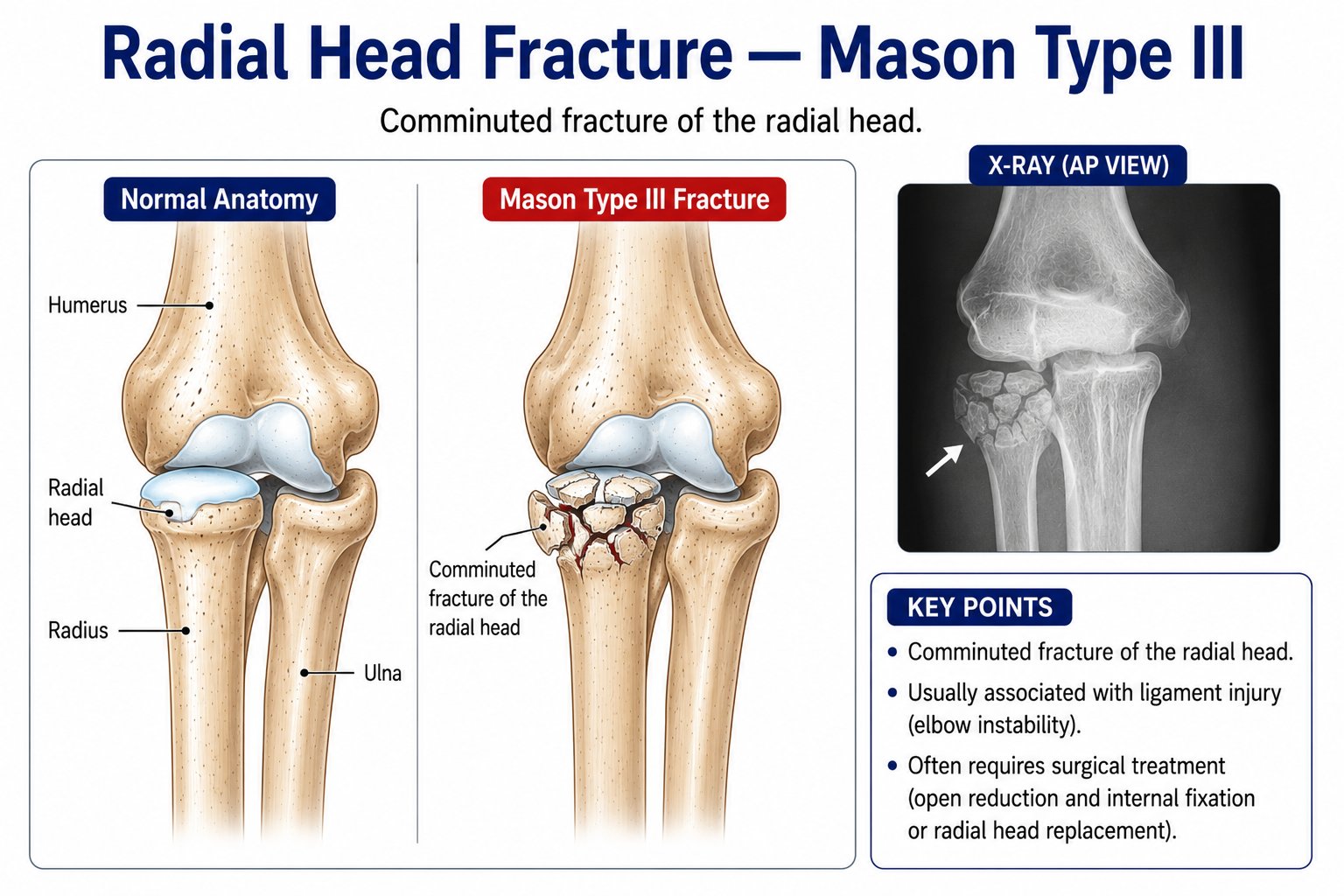
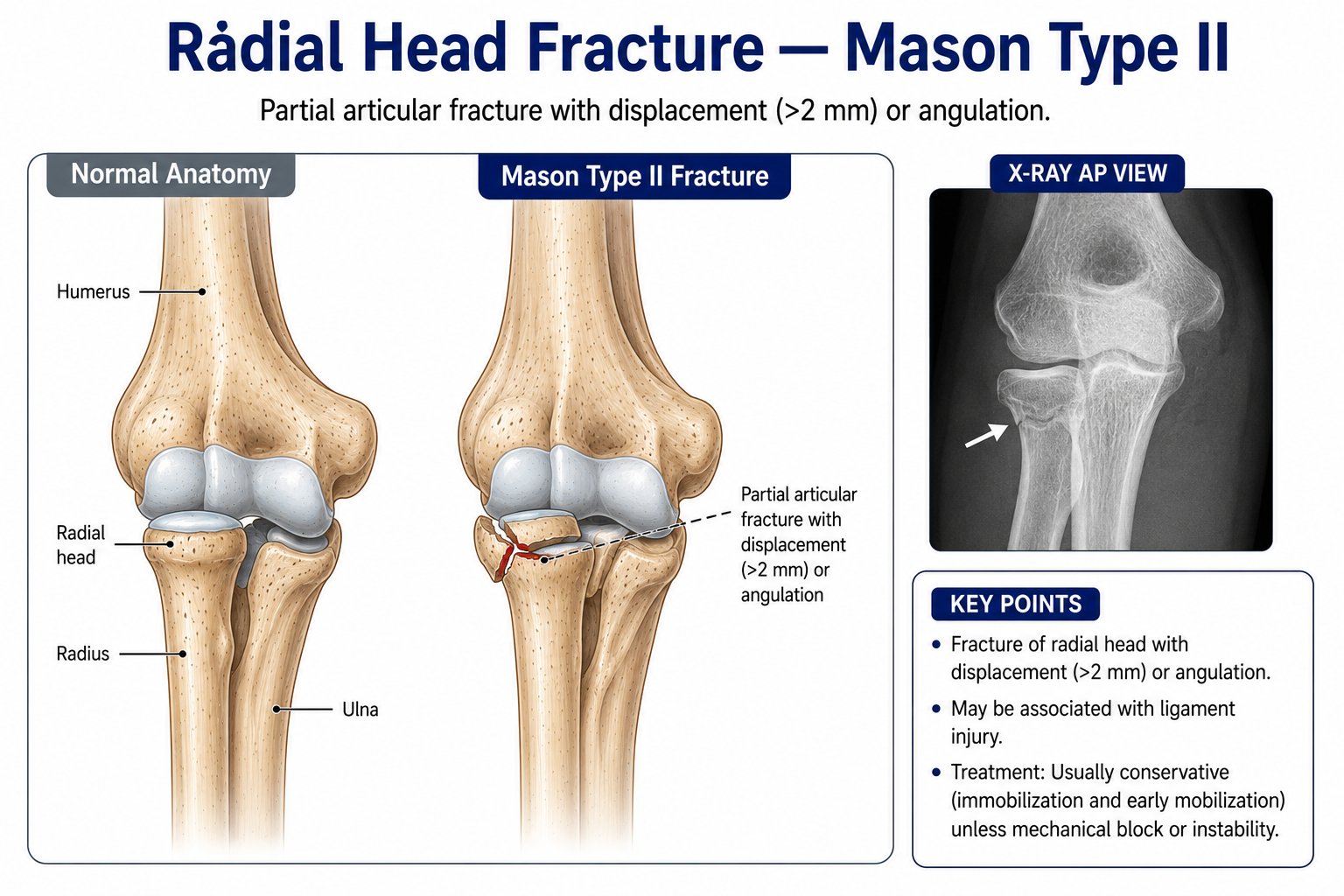
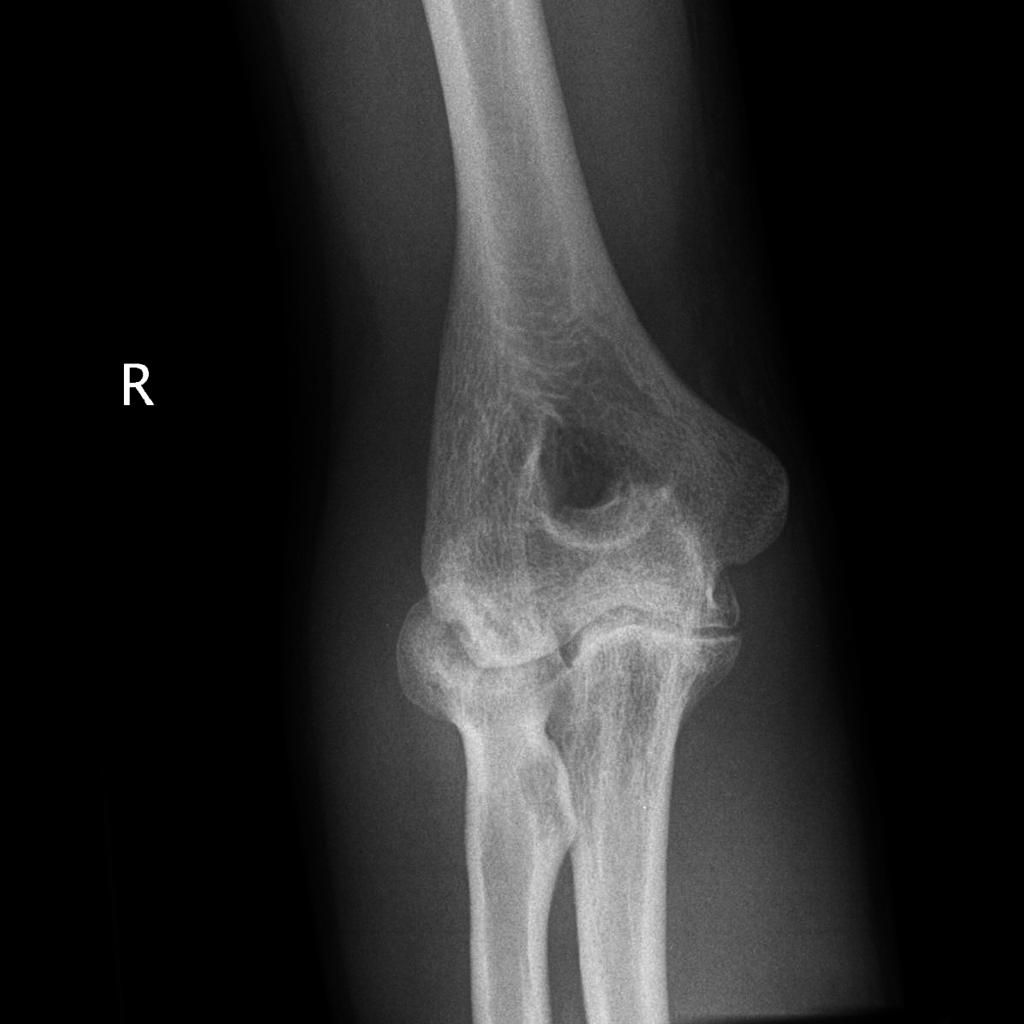
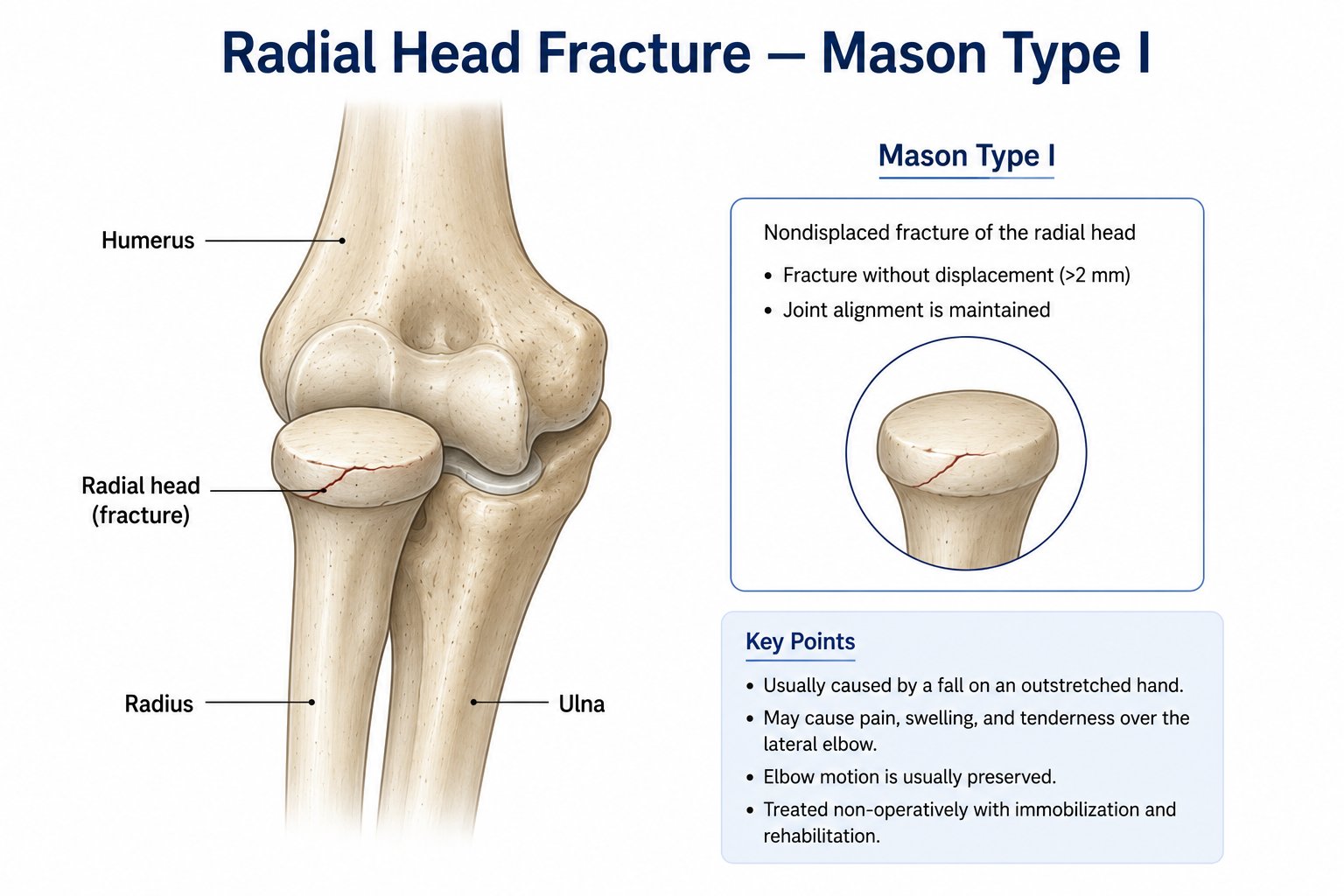
The radial head fracture is one of the most common injuries around the elbow, occurring when a fall onto an outstretched hand transmits an axial load through the forearm to the radial head, which impacts against the capitellum. The Mason classification system categorises radial head fractures by displacement and fragmentation: Type I (non-displaced or <2mm displacement — the subject of this page), Type II (partial articular fracture with >2mm displacement — Condition 46), and Type III (comminuted, head unsalvageable — Condition 47).
Mason Type I fractures are non-displaced or very minimally displaced — the fracture line is present but the fragment has not shifted out of position. The joint surface is essentially congruous. These fractures almost always heal completely with conservative management, provided that early mobilisation is initiated promptly to prevent the elbow stiffness that readily develops after any elbow injury.
The most important immediate intervention for a Mason Type I radial head fracture is aspiration of the haemarthrosis (blood in the joint) and injection of local anaesthetic. The haemarthrosis is the primary cause of acute pain and restricted movement. Aspiration provides dramatic immediate pain relief, allows clinical assessment of whether a true mechanical block to forearm rotation exists (which would change management), and confirms the diagnosis.
Quick Facts | Details |
Also Known As | Mason I Radial Head Fracture, Non-Displaced Radial Head Fracture |
Affected Area | Radial head — the proximal disc-shaped end of the radius that articulates with the capitellum of the humerus and the proximal radioulnar joint |
Who It Affects | Adults of any age; more common in women; typically from a fall onto an outstretched hand; very common fracture accounting for approximately 20% of all elbow fractures |
Prevalence | Radial head fractures are among the most common fractures around the elbow; Mason Type I (non-displaced or minimally displaced <2mm) accounts for approximately 50–60% of radial head fractures |
Treatment | Non-operative: aspiration of haemarthrosis and injection of local anaesthetic for immediate pain relief; sling for 1–2 weeks; early active mobilisation; physiotherapy; NO cast |
Causes & Risk Factors
- Fall onto an outstretched hand — the classic mechanism; axial load transmitted up the forearm through the extended arm; the radial head impacts the capitellum
- Motor vehicle accidents — dashboard or airbag contact with the forearm
- Sports injuries — cycling falls, contact sport tackles
- Osteoporosis — low-energy falls in elderly patients with osteoporotic bone
- Direct blow to the radial head — less common; direct contact over the lateral elbow
Symptoms
- Lateral elbow pain — over the radial head (the lateral aspect of the elbow, below the lateral epicondyle)
- Tenderness on direct palpation — over the radial head; the point of maximum tenderness is 2–3cm distal to the lateral epicondyle
- Restricted and painful forearm rotation — pronation and supination are limited by pain; the key assessment is whether there is a mechanical block (a hard stop) or just pain limiting movement
- Swelling — lateral elbow effusion with haemarthrosis; the “sail sign” on X-ray (anterior fat pad displacement)
- Reduced elbow extension and flexion — from haemarthrosis; typically mild
- Exclude Essex-Lopresti (interosseous membrane injury + distal radioulnar joint disruption) — axial loading with forearm pronation; wrist pain; check the DRUJ in every radial head fracture
How is it Diagnosed?
- Clinical examination — lateral elbow tenderness; assess forearm rotation (pronation + supination); check for mechanical block; assess wrist and DRUJ
- Plain X-rays (AP + lateral) — fracture line through radial head; minimal displacement (<2mm); anterior fat pad sign (haemarthrosis); assess capitellar surface
- CT scan — used selectively: if X-ray shows fracture but there is concern about displacement or articular involvement; also if forearm rotation block is present and mechanism for additional injury is suspected
- Aspiration — aspirate haemarthrosis (15–20ml blood typically); inject 5ml local anaesthetic; reassess forearm rotation after anaesthesia — if full rotation now possible, confirms no mechanical block; if rotation still blocked, CT ± surgery

Treatment Options
Treatment Type | Details |
Aspiration + Local Anaesthetic Injection | Lateral approach with needle at the radiocapitellar “soft spot”; aspirate haemarthrosis; inject 5ml lidocaine; provides immediate dramatic pain relief and allows functional assessment; reduces pressure and accelerates recovery |
Sling for Comfort | Simple sling for 1–2 weeks only; NOT a cast; sling for patient comfort, NOT immobilisation; removed for movement exercises from day 1–2 |
Early Active Mobilisation | The cornerstone of treatment: begin active forearm rotation and elbow flexion-extension from within 24–48 hours of injury; the primary enemy is stiffness — the elbow stiffens rapidly with any immobilisation |
Physiotherapy | Guided active-assisted exercises; progressive range of motion; strengthening commences at 4–6 weeks as pain allows; home exercise programme critical |
NSAIDs | Anti-inflammatory pain management; naproxen or ibuprofen; short course 1–2 weeks; allows earlier comfortable movement |
Serial X-ray at 2–4 weeks | Confirm no secondary displacement of the fracture fragment during the healing period |
Recovery & Rehabilitation
- Excellent prognosis: >95% of Mason Type I fractures heal completely without surgery
- Full range of motion: typically restored within 4–8 weeks with dedicated physiotherapy and early mobilisation
- Return to work: office work within 1–2 weeks; manual work 4–8 weeks
- Return to sport: 4–8 weeks depending on the sport and pain resolution
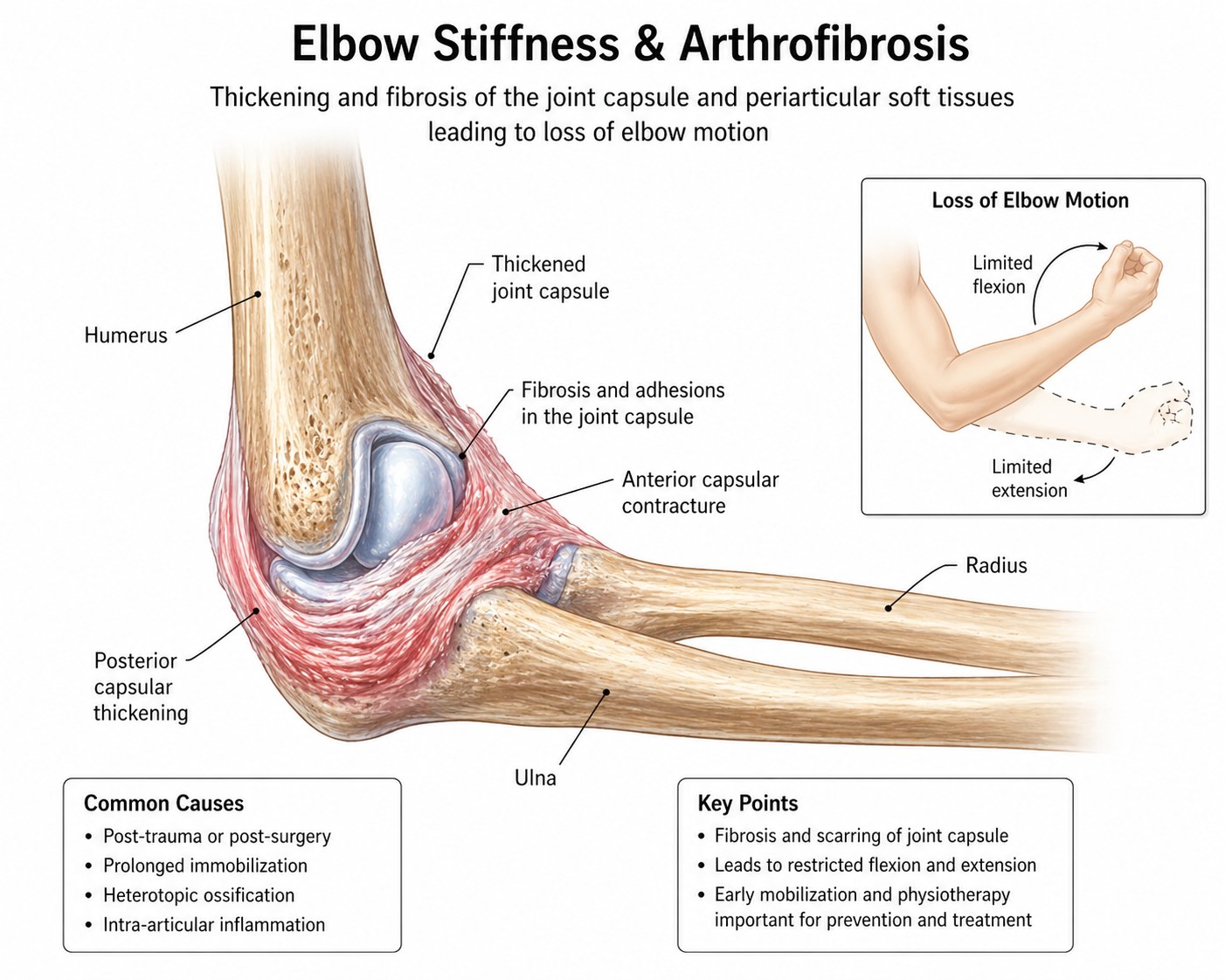
- Most common complication: elbow stiffness from inadequate early mobilisation — avoidable with prompt physiotherapy
- Rare complication: fracture displacement if a mechanical block was initially missed — confirmed by reassessing rotation after aspiration + LA
Why choose Dr Senthilvelan?
Mason Type I radial head fractures are often undertreated — either inadequately mobilised (leading to stiffness) or over-investigated. Dr Senthilvelan’s systematic approach — aspiration with local anaesthetic to assess for mechanical block, early physiotherapy, and selective use of CT when indicated — ensures optimal recovery from what should be a straightforward injury.
Frequently Asked Questions
1. I have a radial head fracture — do I need a cast?
No — a cast is NOT appropriate for a Mason Type I (non-displaced) radial head fracture. Immobilisation in a cast causes elbow stiffness that can take months to fully recover. A simple sling for comfort is provided for the first 1–2 weeks, but active range-of-motion exercises begin within 24–48 hours of the injury. Early movement is the most important treatment. The fracture will heal regardless of whether the elbow is moving — movement does not displace a non-displaced fracture.
2. What is the haemarthrosis aspiration and does it really help?
A haemarthrosis is the accumulation of blood inside the elbow joint after a fracture. This blood causes significant pain, restricted movement, and muscle guarding. Aspiration involves placing a needle into the lateral elbow ‘soft spot’ (between the lateral epicondyle, the radial head, and the olecranon) and drawing out the blood. After aspiration, local anaesthetic is injected to further relieve pain. Most patients notice dramatic improvement in comfort within minutes. Crucially, the aspiration also allows the surgeon to assess whether forearm rotation is blocked by a fracture fragment — which would change management.
3. How long will it take to fully straighten and bend my elbow after a radial head fracture?
With appropriate early mobilisation and physiotherapy, most patients regain full or near-full range of motion within 4–8 weeks. The key is to start moving within 24–48 hours of the injury — the earlier movement begins, the faster and more complete the recovery. Patients who are immobilised for several weeks in a cast consistently take longer to recover and may never fully regain their pre-injury range of motion.
4. My X-ray shows a small fracture but I have a lot of forearm pain during rotation — is this normal?
Some pain with forearm rotation is expected after a radial head fracture, as the radial head participates in the proximal radioulnar joint. However, if there is a hard end-point or mechanical block during rotation (rather than just pain limiting movement), this may indicate a displaced fragment that is mechanically blocking rotation. After aspiration and injection of local anaesthetic, if rotation is still blocked, a CT scan is recommended to assess for a displaced fragment requiring fixation. This is the critical distinction between Mason Type I (no block) and Type II (displaced fragment with potential block) fractures.
5. Do I need to see a specialist for a Mason Type I fracture, or can my GP manage it?
Mason Type I fractures can initially be managed at the emergency department with aspiration and early mobilisation advice. However, a physiotherapy referral is important — the guidance on exercise progression is crucial to avoid stiffness. A specialist review at 2–4 weeks is recommended to confirm there has been no secondary displacement on follow-up X-ray and to assess whether full range of motion is being restored. If range of motion is not recovering as expected at 4–6 weeks, specialist review is essential.